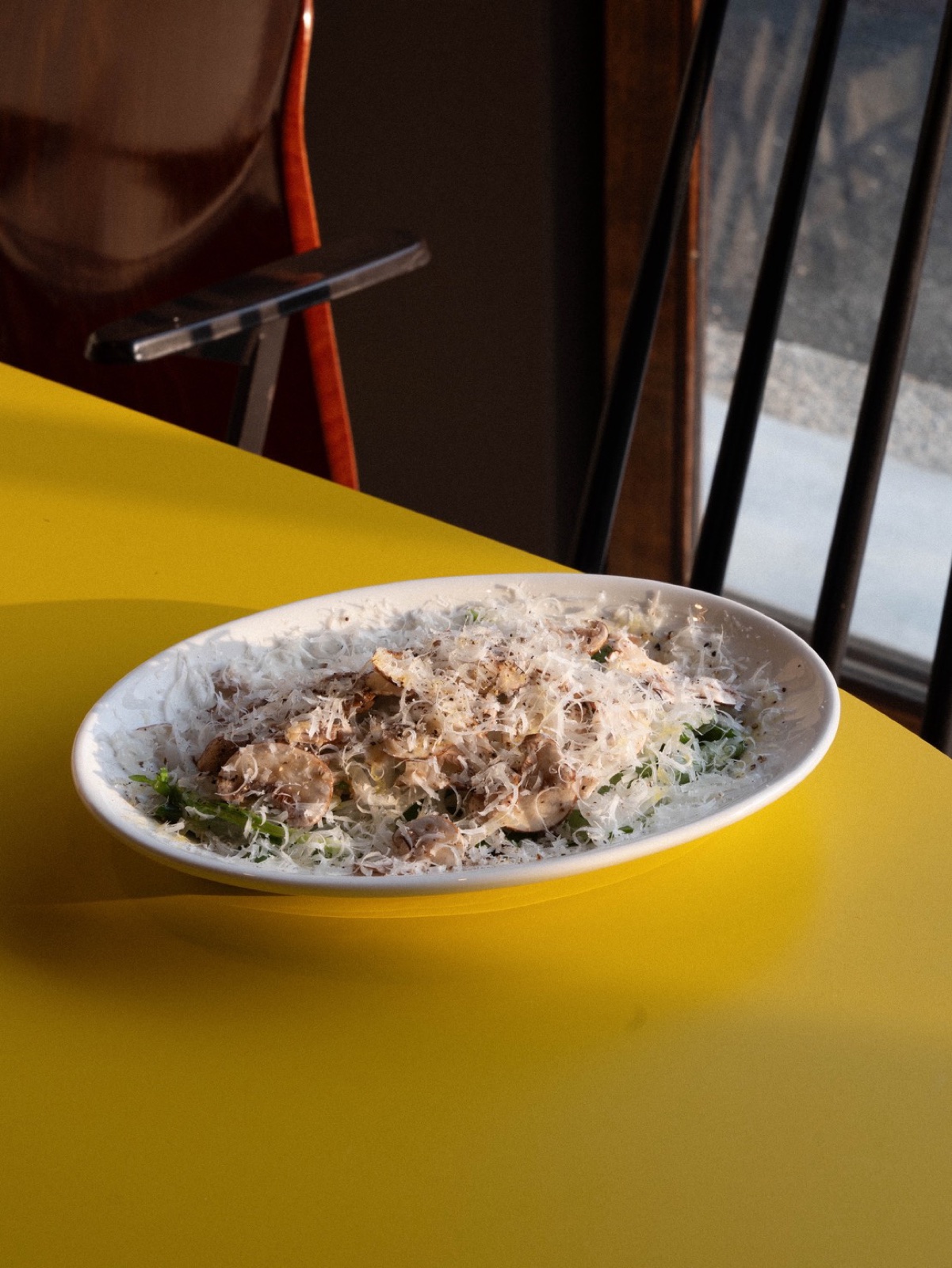
On the antipasto list at Bello Vero, our Italian restaurant in Kitashirakawa, Kyoto, the mushroom and onion salad is a small plate built by subtraction. The mushrooms never see heat — they are simply sliced thin. The onion goes raw too, tossed in a house-made dressing and tucked underneath. To finish, freshly grated Parmigiano Reggiano drifts down over everything like a soft fall of snow. That, and the plate is done.
In Italian it is insalata di funghi crudi — a salad of raw mushrooms. In Piemonte and Lombardia it is an autumn classic, often built around porcini. At Bello Vero we use the year-round champignon mushroom (funghi champignon) and keep the plate light enough to sit comfortably beside a slice of prosciutto or a carpaccio.
The Other Face of a Mushroom — Raw
Mushrooms are usually a cooked ingredient. Pan-fried in butter they turn nutty; simmered into a stew they lend depth — most people know the cooked mushroom by heart. The raw mushroom is a less-remembered creature.
Sliced thin and left uncooked, a mushroom behaves like an entirely different ingredient. The texture turns silken, the aroma far more delicate — a damp forest note that slips quietly to the back of the nose. The volatile compounds that disappear under heat are still there, intact, in the raw slice.
At Bello Vero we pick fresh mushrooms and slice them on the day. Because the cut surfaces darken on contact with air, the plate is built only after the order comes in. The white you see when it lands on the table is the colour of a mushroom that has never been cooked.
The Onion, Married to a House-Made Dressing
Underneath the mushrooms sits a layer of thinly sliced raw onion, already tossed in our house-made dressing. The dressing itself contains onion, so the sweet-tart note of raw onion runs through it as a built-in seasoning. Instead of the pointed acid of a bottled vinaigrette, the softer, onion-derived acidity gathers the whole plate together.
Raw onion can read sharp to some palates, but rested briefly in the dressing the bite settles down and the sweetness comes forward. The delicate forest aroma of the mushroom and the sweet-tart onion form the foundation; the Parmigiano lands on top. Three layers, all doing different work.
The Finish — Freshly Grated Parmigiano Changes Everything
The last gesture is Parmigiano Reggiano, grated to order. Run through a fine grater, it falls in soft, airy flakes — enough to cover the surface of the plate, so that the mushroom slices and onion peek through only here and there. That snowed-over look is half the pleasure of the dish.
Parmigiano is the hard cheese of Emilia-Romagna, aged at least 24 months — granular on the tongue, nutty in the nose. Freshly grated and pre-grated are not the same cheese, as anyone who has held a Microplane over a wedge will tell you. Grating at the table is the ideal; even grating in the pass, moments before the plate goes out, carries that air-borne aroma to the diner.
The salt and umami of Parmigiano give the raw mushroom's quiet aroma a spine, and they pick up the onion's sweet acidity on the way down. Three ingredients, each doing its own job, none crowding the others — that is how a subtraction dish actually works.
How to Eat It — Don't Stir from Below; Work from the Top
When the plate arrives, take the first bite from the top: a forkful of Parmigiano and mushroom together. Cheese-salt and mushroom-aroma meet first on the tongue. The next forkful goes deeper and brings up the dressed onion, and the dressing's acid suddenly lifts the flavour into three dimensions.
If you stir the plate from the bottom, the Parmigiano soaks up the onion's moisture and turns pasty. Work from the top, breaking the layers gently — that is the way this plate eats best. The dressing pooled at the bottom at the end is for wiping up with a piece of house-made focaccia.
Mushroom & Onion Salad
Thin slices of raw mushroom over onion tossed in our house-made dressing, blanketed with freshly grated Parmigiano like soft snowfall. An antipasto built by subtraction.
About the Italian Classic — funghi crudi
Slicing raw mushrooms and eating them with oil, lemon, and Parmigiano is an old habit in northern Italy, especially in Piemonte and Lombardia. Porcini in autumn, ovoli (Caesar's mushroom) in summer, and the year-round champignon de Paris — whichever mushroom is at its best gets eaten without heat.
The classical recipe is short: sliced mushrooms, olive oil, lemon juice, Parmigiano, black pepper. Bello Vero's version adds raw onion and a house-made dressing to that line. In place of lemon, the onion's acidity inside the dressing takes the acid role, and the onion itself adds texture and sweetness. The classical skeleton stays; the footing shifts a little.
A First Plate for the Vegetarian Diner
This salad is a complete vegetable-plus-mushroom-plus-cheese dish, with no meat or fish involved. Bello Vero accommodates vegetarian needs on some items and on request, so it works well as a first plate for a vegetarian guest. If you have questions about ingredients or preparation, please ask us when you arrive or when you book.
On the same antipasto line, the carrot rapé (finely grated carrots, French-style), the caponata (Sicilian sweet-sour vegetable stew), and the seasonal vegetable fritto — 6 kinds sit nearby. Two or three coloured small plates side by side, and the table opens up.
Wines to Pair — Light Whites, Dry Sparkling
Mushroom and onion salad wants a light white wine that won't trample its delicate aroma. Northern Italian Soave and Friulano, Sicilian Catarratto and Grillo — wines with minerality and fruit-led acid that spread the forest aroma and the Parmigiano umami sideways instead of stacking them.
A skin-contact orange wine is another good partner. The skin-fermented whites of Friuli — Ribolla Gialla, Verduzzo Friulano — carry a particular weight that resonates with the earthy note of raw mushroom. Bello Vero usually has a few orange wines from Friuli and the Slovenian border on the list, so it's worth a look on the day.
For bubbles, dry spumante, crémant, or Champagne. Parmigiano salt meeting bubbles makes a tidy first glass. Wine at Bello Vero is by the bottle only, with Champagne by the glass the lone exception. Champagne and this small plate to open the evening — a quiet little luxury for a Kitashirakawa night, but never a formal one.
Subtraction Cooking Is the Hardest Cooking
Mushroom, onion, Parmigiano, dressing. Four ingredients, no heat. To make a plate stand on so little, the freshness and quality of each piece have to land on the palate as themselves — which is why subtraction cooking is the hardest cooking. Tired mushrooms have no aroma; over-sharp onion breaks the whole plate; an ordinary Parmigiano drops the level of the dish on its own.
The reason this salad stays on the menu at Bello Vero is that we can put those four pieces together properly every day. The mushrooms are picked fresh, the onion is seasonal, the Parmigiano is bought in wedges and grated to order, and the dressing is made in-house. Small daily habits, holding up a simple plate.
A Raw-Mushroom Antipasto, in Kyoto
Search "Kyoto mushroom salad" and you don't find very many places treating raw mushroom as the lead. In Japanese cooking, mushrooms are an ingredient you cook — eating them raw, sashimi-style, is the minority view. The northern-Italian funghi crudi sitting on a small plate on a Kitashirakawa evening is one of Bello Vero's small particulars.
After Ginkakuji and the Philosopher's Path, a glass of wine, and a slow demolition of a white Parmigiano snowfall — please come and try this quiet antipasto.
Kitashirakawa, on the Edge of Kyoto — A Hidden Gem 15 Minutes from Ginkakuji
Kitashirakawa is one of those Kyoto corners where the tourist trail and the local neighbourhood overlap. Walk 10 to 15 minutes north from Ginkakuji along Shirakawa-dori and you're here. The northern end of the Philosopher's Path is within 10 minutes on foot. With Kyoto University and Kyoto University of the Arts close by, students and long-time residents have shared these streets for years.
Many restaurants near Ginkakuji close by 17:00 or 18:00, leaving travellers stuck for dinner after the sightseeing is done. Bello Vero stays open from 13:00 to 22:00, so a late dinner after a slow walk along the Philosopher's Path, or a long afternoon glass of wine, both fit. A light visit — just a small plate and a glass of wine — is welcome too.
The Antipasto Lineup
Bello Vero keeps a full antipasto and contorno line around the day's vegetables and fish. Beyond the mushroom and onion salad, choose by the mood:
- Carrot Rapé
- Caponata
- Seasonal Vegetable Fritto — 6 kinds
- Fried Potatoes with Anchovy Garlic Butter
- Jamón Serrano
- Semi-Dried Tomato Caprese
- Fish Carpaccio / Beef Carpaccio
- Homemade Focaccia
Getting Here from Ginkakuji & the Philosopher's Path
After Ginkakuji, head north along Shirakawa-dori and you arrive in 10 to 15 minutes on foot. From the northern end of the Philosopher's Path it is within 10 minutes. The nearest bus stop is "Kitashirakawa" (about 2 min on foot), and from Eizan Railway "Chayama · Kyoto University of the Arts" station it is about 10 minutes.
📍 64-17 Kitashirakawa Kubota-cho, Sakyo-ku, Kyoto
🕐 Tue–Sun 13:00–22:00 (L.O. 21:30) / Closed Monday
🚶 ~15 min from Ginkakuji / ~12 min from the Philosopher's Path / 2 min from Kitashirakawa bus stop
📅 Reservations: Book online / TableCheck or call +81 75 600 0740