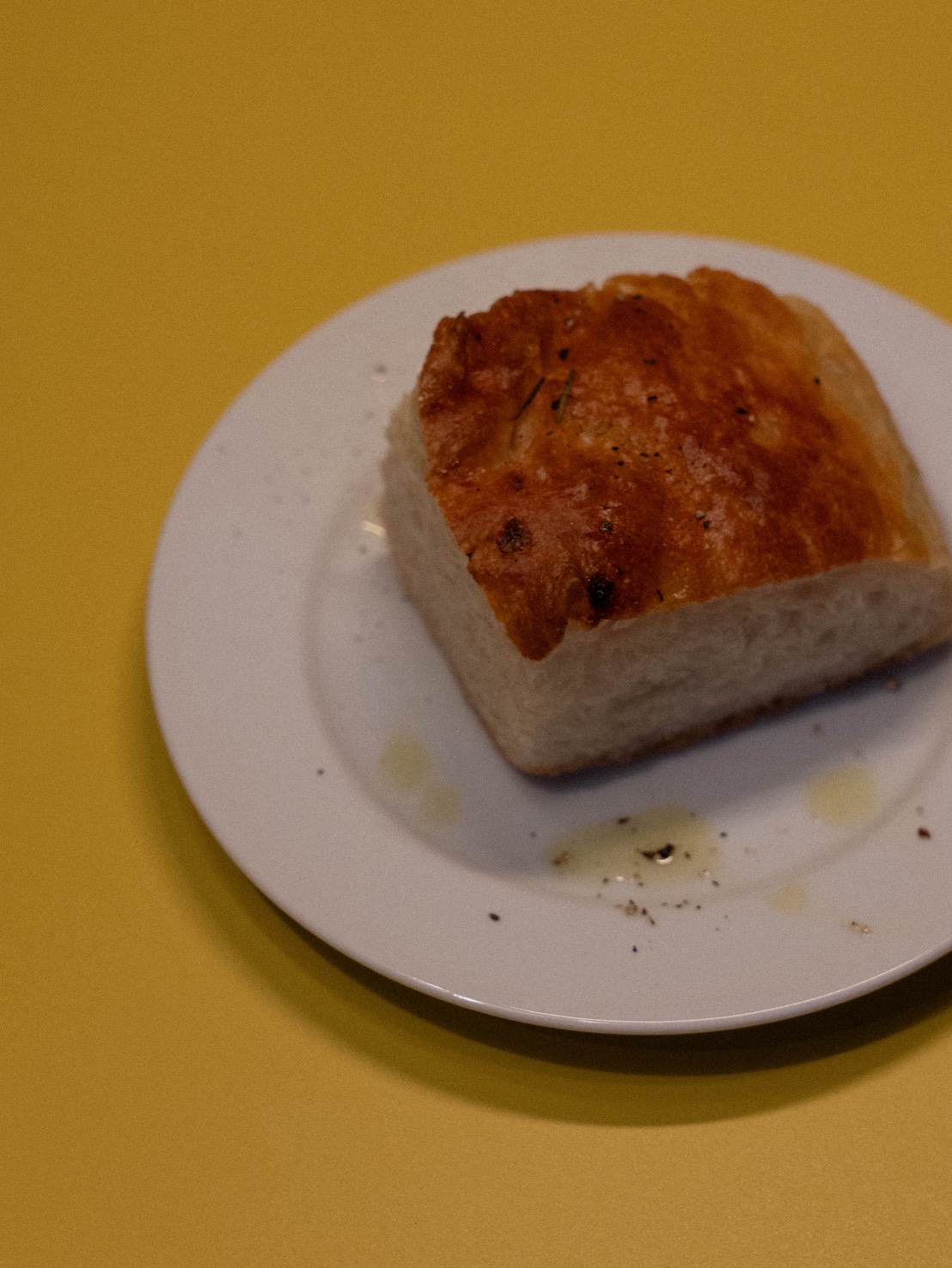
The name focaccia comes from the Latin panis focacius. focus in Latin means "hearth" — and so, at its oldest, focaccia is simply "bread baked at the hearth."
Long before the oven became the centre of the kitchen, ancient Romans flattened their dough and baked it on hot stones, or directly on the ash of the hearth. One of the earliest ancestors of Italian bread has made it all the way to our modern table — and that is what focaccia is.
Perfected in Genoa
The focaccia we picture today — soaked in good olive oil, salty and golden — grew up in the port city of Genoa, in Liguria. It is called focaccia genovese: the baker presses dimples into the surface with their fingers, pools high-quality olive oil and salt into those dimples, and slides it into the oven.
Those finger dimples are not only for looks. As the bread bakes, the oil soaks down into the dough, creating that signature contrast of a crisp, oily top and a tender, moist interior. The Ligurian culture of olive oil and sea salt is sealed into a single slice.
A Bread That Changes Face by Region
Focaccia is loved all over Italy, but it looks and tastes very different from one region to the next.
- Liguria — thinner, drenched in olive oil, with bold salt. The standard.
- Puglia (focaccia barese) — thicker, from the south, topped with cherry tomatoes and olives.
- Veneto (focaccia veneta) — enriched with eggs and butter, sweet and soft, an Easter bread.
A single word, "focaccia," opens into that many different worlds. Pizza's ancestor sits in Naples; modern focaccia settles in Genoa. The bread map of Italy is always a complicated, fascinating thing.
How We Serve It at Bello Vero
The focaccia at Bello Vero, the Italian restaurant in Kitashirakawa, stands in the Ligurian tradition. Plump and well baked, finished on top with olive oil and a coarse grind of black pepper. Because it is so simple, the scent of wheat and oil lifts up straight and clean.
Enjoy it as an opener with a glass of Champagne or the foam of a Peroni. But ask any Italian how focaccia is really meant to be eaten, and most will answer: "Use it to wipe up the sauce left on your pasta plate."
Focaccia — with olive oil and black pepper
Same menu served all day from lunch through dinner.
Scarpetta — Wiping the Plate with Bread
Italians have a name for this gesture: fare la scarpetta — literally, "to make a little shoe." When you tear off a piece of bread and drag it across the plate, it moves across the sauce like a small shoe sliding over the ground. That is the most commonly cited origin of the phrase.
In Japan it might be seen as bad manners to wipe your plate with bread. In Italy, the opposite is true. To taste a good sauce down to the last drop, and to tell the cook "I finished it, every bit" — that is considered the highest form of respect for the dish and for whoever made it. At formal dinners, there is even a more elegant move: spear the bread on a fork and wipe with that.
In a real sense, the focaccia at Bello Vero is baked for this scarpetta. The chilli heat of arrabbiata, the deep juices of beef-tendon bolognese, the pool of half-melted mozzarella on alla Sorrentina — on each plate, the last wipe is the best wipe. The ideal ending: your pasta plate is empty, and your focaccia is gone at the same time.
Leftover sauce, in the Italian kitchen, is "another small course in its own right." Focaccia is the bread built to catch that final course.
Something to Drink With It
Focaccia gets along with almost any drink. We usually suggest one of these:
- Champagne by the glass — fine bubbles meet the oil and the toasted edges.
- Peroni — the Italian pilsner. Its bitterness sits well against the salt.
- Red wine (by the bottle) — a warm-up before the pasta arrives.
A Quieter Edge of Kyoto — Kitashirakawa
Kitashirakawa is a corner of Kyoto where tourist and local quietly overlap. Ten to fifteen minutes' walk north from Ginkakuji along Shirakawa-dori, and you are here. It is also within ten minutes of the northern end of the Philosopher's Path. With Kyoto University and Kyoto University of the Arts just around the corner, students and long-time residents have mixed in these streets for generations.
In a place like this, you can sit with a piece of bread whose lineage reaches ancient Rome, a drizzle of olive oil, a crack of black pepper — and give it the time it deserves, a step away from the tourist centre.
Getting Here from Ginkakuji & the Philosopher's Path
After visiting Ginkakuji, simply head north along Shirakawa-dori; you will arrive in 10 to 15 minutes on foot. From the northern end of the Philosopher's Path, it is within 10 minutes as well. The nearest bus stop is "Kitashirakawa" (about 2 min on foot), and from Eizan Railway "Chayama·Kyoto University of the Arts" station it is roughly 10 minutes.
📍 64-17 Kitashirakawa Kubota-cho, Sakyo-ku, Kyoto
🕐 13:00–22:00 (L.O. 21:30) / Irregular closing days
2 min from "Kitashirakawa" bus stop / about 15 min from Ginkakuji
📅 Reservations: Book online / TableCheck or call +81 75 600 0740