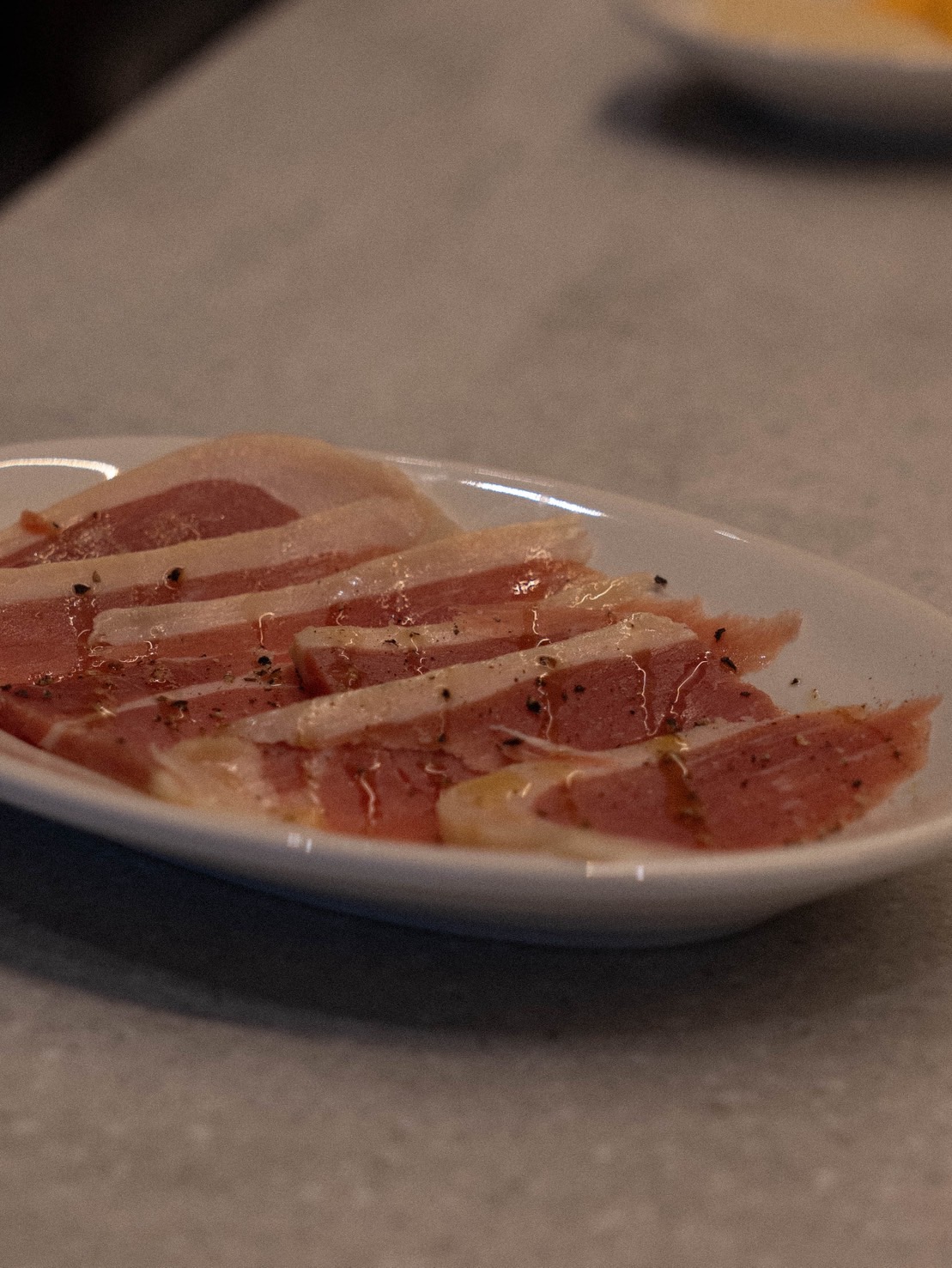
Jamón serrano is the hind leg of a Spanish white pig, salt-cured and then aged for many months in the cold mountain air. Jamón is Spanish for cured ham; serrano means "of the mountains" — and that is exactly where it is made, in the dry, high-altitude air of inland Spain. The balance of fat and lean, the way the salt rounds off, the slow build of umami as you chew — a single thin slice tells you most of what Spanish food culture is about.
At Bello Vero, our Italian restaurant in Kitashirakawa, Kyoto, the antipasto list carries a Jamón Serrano — sliced thin, fanned across the plate, finished with cracked black pepper and a thread of olive oil. Spanish bars serve their hams plain, with nothing added, alongside a glass of wine. We serve it the same way.
Serrano vs. Ibérico
Spanish hams come in two main families: jamón serrano and jamón ibérico. The first uses white pig breeds; the second uses the native Ibérico (a black-pig lineage). They differ in price and in the texture of the eating: ibérico carries a roasted, almost nutty depth in the fat, while serrano sits more on the lean side, with a clean salinity and a firmer chew.
Serrano is the everyday ham of Spain — what you'll find on the bar counter, in the grocer's, at the family table. It is made the same broad way as Italy's Prosciutto di Parma: salt, air, time. The differences in pig breed, salting, humidity and curing length give it a slightly drier, more pronouncedly salty profile than Parma's softer, sweeter feel. Neither is "better" — they're each a country's best answer to the same question.
Bello Vero's Plate, Sliced Thin
We slice the jamón serrano thin and lay it across the plate, finish it with a turn of the pepper mill and a careful drizzle of olive oil — and that is the dish. As the slices come up to room temperature, the fat starts to soften, the surface picks up a faint sheen, and the salt opens out into a longer, sweeter flavour. That moment is the one to eat it in.
Take a slice with a fork, eat it as it is — or lay it on a piece of our homemade focaccia for an open-face bite. Spanish bars pair their ham with bread (pan con jamón); our focaccia, soft and folded with olive oil, takes the salt of the ham comfortably.
Jamón Serrano
Spanish dry-cured ham, sliced thin. Cracked black pepper, olive oil — a quiet plate, made for wine.
Why a Spanish Ham at an Italian Restaurant?
Bello Vero is an Italian restaurant, and yet the menu carries jamón serrano. The reason is straightforward: Mediterranean Europe doesn't end at Italy's border. Spain, southern France, Portugal, North Africa — the culture of olive oil, cured meats and fermented breads runs all the way around the basin without a clean break. The Sicilian caponata still carries traces of Islamic influence; an Italian table next door to Spain has always been within reach.
Wine works the same way. From Piemonte through Liguria to southern France, into Catalonia and Rioja — the Mediterranean coastline carries its grapes and its soils in a continuous line. Pouring a Spanish ham onto an Italian menu is one small way of putting that continuity onto the plate.
Wines to Pair — Spanish Whites, Sherry, a Lighter Red
The classic match is a Spanish white. Albariño, with its sea-air freshness, falls into perfect step with the salt of the ham. The whites of Galicia and the Rías Baixas in the northwest carry mineral and citrus acidity that cleans the palate after each slice.
To go more Spanish still, look at Sherry (Jerez) — a dry Fino or Manzanilla, aged under the layer of flor yeast, gives back the same kind of salty, savoury depth the ham has, and the pairing of cured ham with dry sherry is one of the oldest classics in Spanish food. We can't promise sherry is in the cellar on any given night, but if it is, ask.
For red, look for soft tannin and forward fruit: a young Tempranillo, a Piemontese Barbera, a southern French Grenache — Mediterranean reds without too much oak. Heavy, oaky reds tend to clash with the saltiness and turn metallic. For sparkling, a dry Cava or an Italian spumante lifts the salt with bubbles.
Wine at Bello Vero is by the bottle only; Champagne is the sole by-the-glass exception. Starting an evening with jamón and a glass of Champagne is a small luxury that suits a quiet Kitashirakawa night surprisingly well.
Cured vs. Raw — Beside the Beef Carpaccio
The antipasto list has another thin-sliced meat plate: Beef Carpaccio. Raw beef sliced paper-thin, dressed with lemon, Parmigiano and olive oil — Italy's own minimal cured-meat answer.
Same outline — thin-sliced meat × olive oil × salt — but two opposite logics. Jamón serrano is meat made by long curing; carpaccio is raw meat seasoned at the moment of serving. One is built by time, the other by freshness. Order both and the breadth of the Mediterranean's salt-and-meat tradition opens out across two plates.
A Spanish Ham, in Kyoto
Search "Kyoto jamón serrano" and the results are mostly Spanish bars and a few wine bars in central Kyoto — Gion, Kiyamachi, Karasuma. In the Ginkakuji and Kitashirakawa area to the east, restaurants serving it are uncommon. A thin-sliced Spanish ham, served properly, in this corner of Kyoto, is one of Bello Vero's quieter signatures.
In Japan, cured ham often comes paired with melon — prosciutto e melone, the classic Italian summer pairing from the area around Rome, where cold sweet fruit meets the salt of the ham. The Spanish habit is different: the ham stands on its own, no melon, just bread and wine. We serve our jamón serrano in that second style.
A Hidden Gem in Kitashirakawa — 15 Minutes on Foot from Ginkakuji
Kitashirakawa is the corner of Kyoto where the tourist trail and the local neighbourhood overlap. Walk 10 to 15 minutes north from Ginkakuji along Shirakawa-dori and you are here. The northern end of the Philosopher's Path is within 10 minutes. With Kyoto University and Kyoto University of the Arts just nearby, students and long-time residents mingle in these streets.
Most restaurants near Ginkakuji close by 17:00 or 18:00, leaving travellers without a place to eat after dark. Bello Vero stays open from 13:00 to 22:00, so the Silver Pavilion in the afternoon and a relaxed late dinner afterwards both fit the same day. Even a light stop — just ham and a glass of wine — is welcome.
The Antipasto Lineup
Bello Vero keeps a full antipasto and contorno list. Beyond the jamón, order whichever fits the mood:
- Jamón Serrano
- Caponata
- Seasonal Vegetable Fritto — 6 kinds
- Fried Potatoes with Anchovy Garlic Butter
- Semi-Dried Tomato Caprese
- Carrot Rapé
- Mushroom and New Onion Salad
- Fish Carpaccio / Beef Carpaccio
- Homemade Focaccia
Getting Here from Ginkakuji & the Philosopher's Path
After Ginkakuji, head north along Shirakawa-dori and you arrive in 10 to 15 minutes on foot. From the northern end of the Philosopher's Path it is within 10 minutes. The nearest bus stop is "Kitashirakawa" (about 2 min on foot), and from Eizan Railway "Chayama · Kyoto University of the Arts" station it is about 10 minutes.
📍 64-17 Kitashirakawa Kubota-cho, Sakyo-ku, Kyoto
🕐 Tue–Sun 13:00–22:00 (L.O. 21:30) / Closed Monday
🚶 ~15 min from Ginkakuji / ~12 min from the Philosopher's Path / 2 min from Kitashirakawa bus stop
📅 Reservations: Book online / TableCheck or call +81 75 600 0740