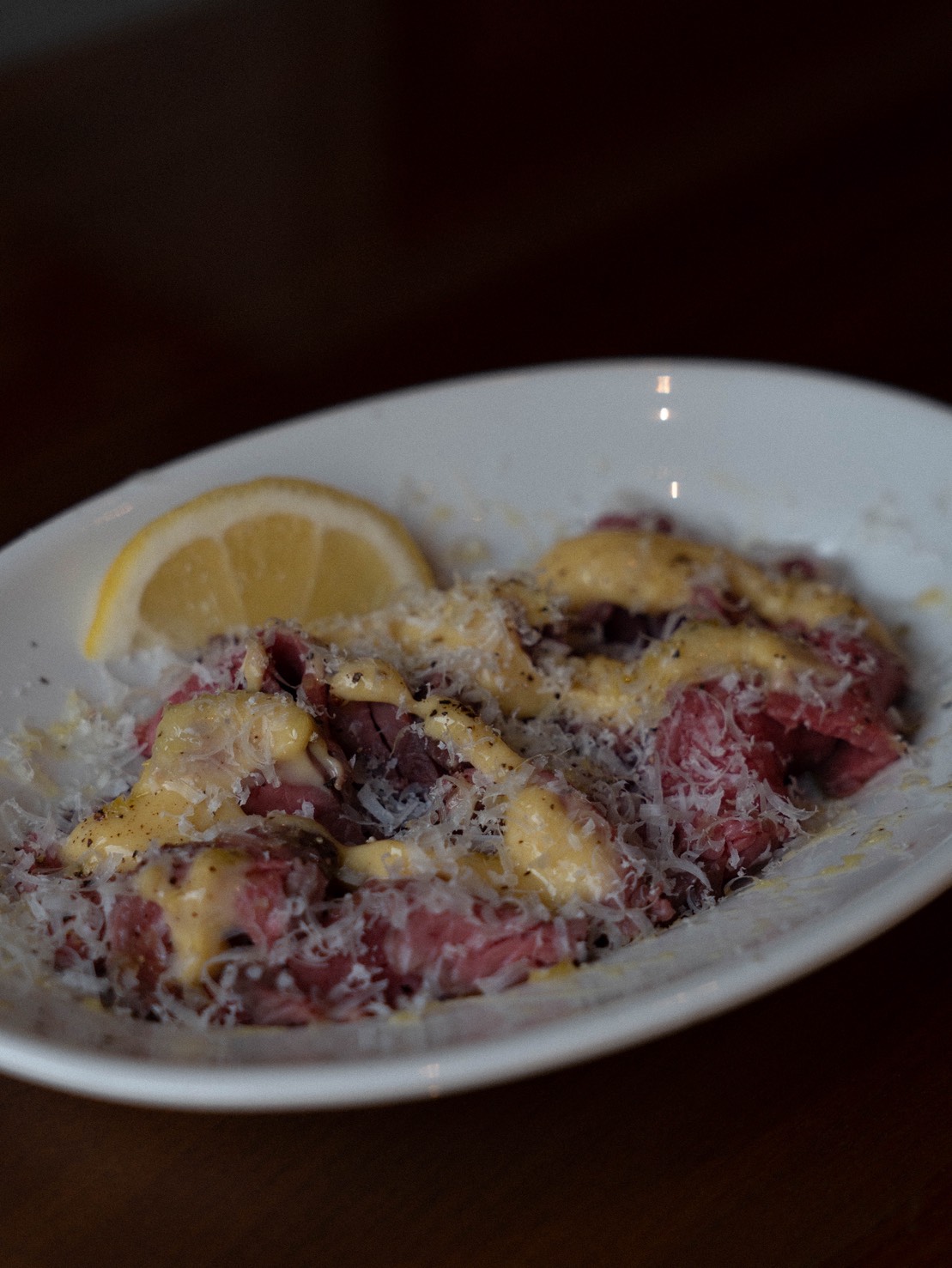
Carpaccio was born at Harry's Bar in Venice in the 1950s: paper-thin slices of raw lean beef under a mayonnaise-based sauce. Owner Giuseppe Cipriani named the dish after the Venetian painter Vittore Carpaccio, whose canvases were dominated by the same red-and-white palette. From that moment on, carpaccio became one of the classic Italian antipasti.
At Bello Vero, the hidden-gem Italian restaurant in Kitashirakawa, Kyoto, the "Beef Carpaccio" goes back to that Venetian starting point and quietly rewrites it for a Kyoto evening — a plate built around a glass of wine rather than a showpiece on a banquet table.
Lean Beef — Thin, and Cold
In carpaccio, the meat itself is the dish. With no cooking to hide behind, there is nowhere to cheat. The quality of the lean cut, the thickness of the slice, and the temperature — all three land directly on the plate.
Bello Vero's beef carpaccio starts from a soft, lean cut chilled thoroughly at low temperature, then cut paper-thin on the slicer. Cut too thick and the weight of the meat steps forward; the lightness of an antipasto is lost. Cut thin, there is a moment where the slice seems to melt in the mouth — and that is precisely when the acidity of lemon, the salt of Parmigiano Reggiano and the perfume of olive oil are meant to arrive. One bite, one quiet crescendo and then release.
Lemon, Parmigiano, Black Pepper, Olive Oil
The finishing is as plain as it gets. A squeeze of lemon. Parmigiano Reggiano shaved over the top like a dusting of snow. Cracked black pepper. A thread of extra-virgin olive oil. That is all.
No showy sauce, no aromatic vegetables are needed here. Lemon meets the iron of the lean beef and turns it sweet; Parmigiano carries the salt and umami; black pepper tightens the finish; the olive oil stretches a thin film across everything and ties it together. This is an antipasto that works by subtraction — that quiet pleasure is the point of the whole plate.
Beef Carpaccio — Lemon, Parmigiano, Black Pepper, Olive Oil
Same menu served all day from lunch through dinner.
Raw Beef in Kyoto — a Second Way
Mention raw beef in Kyoto and most people think of yukhoe, sakura yukke, tataki, or a Japanese-style carpaccio with soy sauce and yuzu-pepper. All good in their own right. But raw beef in the Italian mode — lemon, cheese, olive oil — lives in a different register entirely.
Bello Vero's carpaccio is an antipasto eaten with salt and acid, not soy. No searing power of a wagyu steak, no sesame-oil fragrance of yukhoe. Instead: the iron of lean beef, the fermented depth of aged cheese, the citrus of lemon, the green edge of olive oil — combined in one plate, in Kitashirakawa, taken slowly over a glass of wine. There are not many places to do that sitting down in this part of Kyoto.
Wines to Pair
Beef carpaccio sits better with a lighter red or an orange wine than with a heavyweight bottle. A northern Italian Schiava, a young Pinot Nero, or a Nebbiolo on the younger side — medium-bodied, tannins tucked in, acidity forward — is a very comfortable first choice. If you prefer white, a Chardonnay without too much oak, or a Soave Superiore from the Veneto.
The other direction we would push is an orange wine. The tannin and body drawn from skin contact meet the Parmigiano head-on and, from the inside, unwind the iron of the raw beef. Bello Vero keeps a rotating list of freshly arrived natural wines, so ask for what fits the plate on the night.
Wine is served by the bottle only; Champagne is the sole exception and can be ordered by the glass. A glass of Champagne to start, then a lighter red or an orange for the bottle — an evening that begins with carpaccio tends to unfold very comfortably from there.
A Hidden Gem in Kitashirakawa — 15 Minutes on Foot from Ginkakuji
Kitashirakawa is a distinctive corner of Kyoto where the tourist and the local overlap. Walk 10 to 15 minutes north from Ginkakuji along Shirakawa-dori and you are here. It is also within 10 minutes' walk of the northern end of the Philosopher's Path. With Kyoto University and Kyoto University of the Arts just nearby, students and longtime residents have always mingled in these streets.
Most restaurants near Ginkakuji close by 17:00 or 18:00, which leaves late-afternoon travellers without many options for dinner. Bello Vero stays open from 13:00 through 22:00, so the Silver Pavilion or the Philosopher's Path in the afternoon and a relaxed late dinner afterwards both fit into the same day. Drop in as a hidden-gem stop in Kitashirakawa, whether for early wine or a proper evening meal.
The Antipasto Lineup
Bello Vero keeps a proper antipasto list. Alongside the beef carpaccio, a daily fish carpaccio is also on the menu. Order whichever fits the mood:
- Beef Carpaccio
- Fish Carpaccio (daily)
- Semi-Dried Tomato Caprese
- Carrot Rapé
- Mushroom and New Onion Salad
- Caponata
- Jamón Serrano
- Fried Potatoes with Anchovy Garlic Butter
- Seasonal Vegetable Fritto — 6 kinds
- Homemade Focaccia
Getting Here from Ginkakuji & the Philosopher's Path
After visiting Ginkakuji, head north along Shirakawa-dori and you will arrive in 10 to 15 minutes on foot. From the northern end of the Philosopher's Path it is also within 10 minutes. The nearest bus stop is "Kitashirakawa" (about 2 min on foot), and from Eizan Railway "Chayama · Kyoto University of the Arts" station it is about 10 minutes.
📍 64-17 Kitashirakawa Kubota-cho, Sakyo-ku, Kyoto
🕐 13:00–22:00 (L.O. 21:30) / Irregular closing days
🚶 ~15 min from Ginkakuji / ~12 min from the Philosopher's Path / 2 min from Kitashirakawa bus stop
📅 Reservations: Book online / TableCheck or call +81 75 600 0740