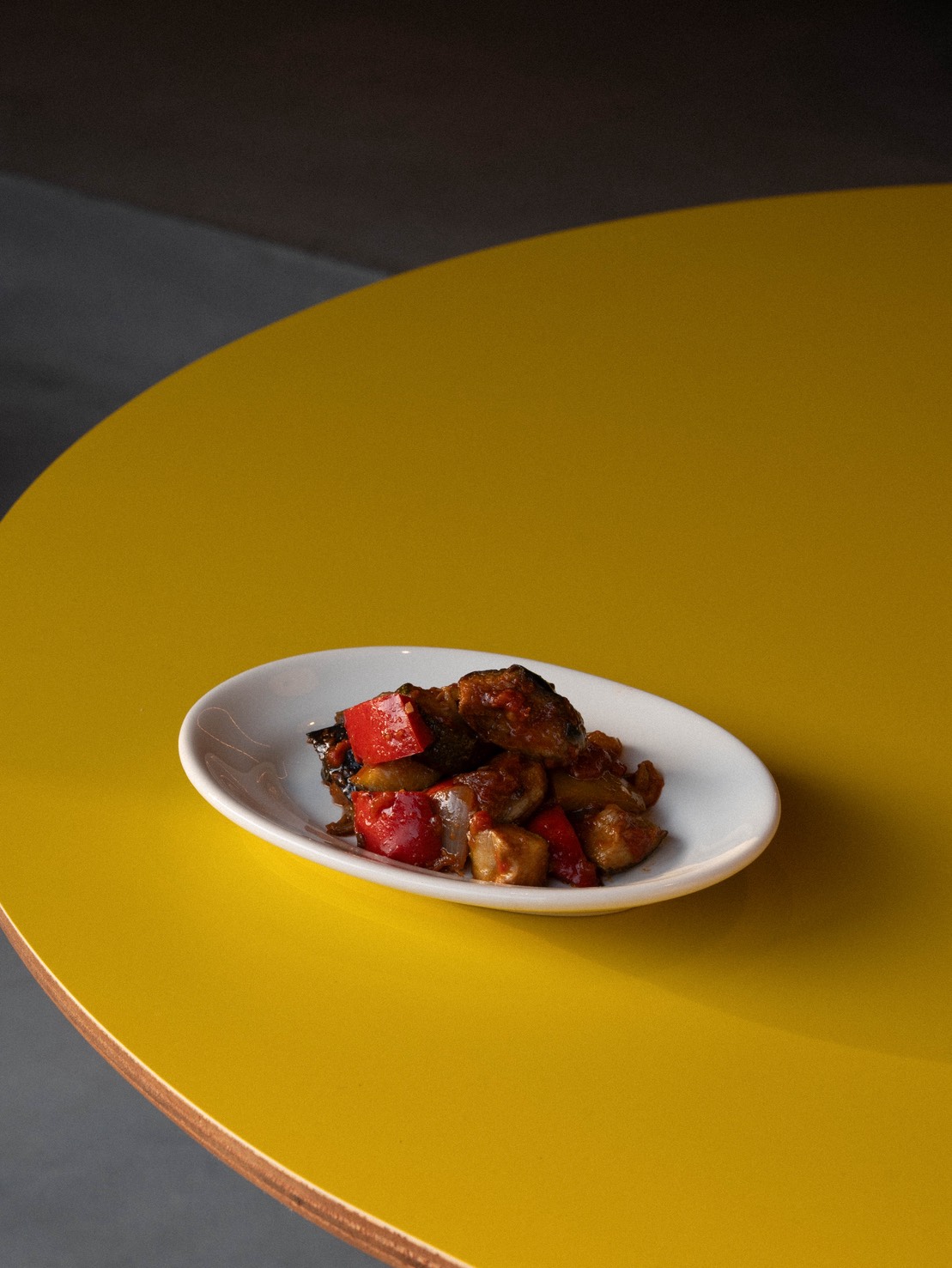
Caponata is the antipasto of Sicily — that island at the toe of the Italian boot, dropped into the Mediterranean. Eggplant, onion, celery, tomato — vegetables raised on a sun that hardly stops — fried separately in oil, then brought together at the end with wine vinegar and a small amount of sugar. The plate can come cold, room temperature, or warm. The vegetables hold their shape; the acid and the sweetness slowly fold into them. It is an antipasto with an unusual kind of calm.
At Bello Vero, the hidden-gem Italian restaurant in Kitashirakawa, Kyoto, the menu carries a Caponata built around eggplant, red pepper and onion, with whatever other vegetables came in that day. It has the proper agrodolce direction — Italian for "sour-sweet" — written into it.
The Sicilian Word: Agrodolce
One of the keys to reading Sicilian cooking is agrodolce — sour-sweet. Centuries of contact with the Islamic world left the island with a taste-vocabulary of raisins and pine nuts, saffron and spice, and the habit of pairing vinegar with sugar. Caponata is the textbook example. The eggplant is fried golden; onion and celery are taken slowly in another pan; tomato joins them, and at the very end wine vinegar and sugar are stirred in for a final brief simmer. As the dish cools, the acid and the sweetness sink into the vegetables.
The result is not a tomato pasta sauce, and not a ratatouille either. Where a French ratatouille goes for "the unity of vegetables and olive oil," caponata holds onto the contrast — sour and sweet kept distinct. The first bite is sharply defined, and the wine glass empties faster than expected.
Bello Vero's Caponata, with the Day's Vegetables
Classical Sicilian caponata is eggplant, celery, onion, tomato, olives and capers. Depending on the town and the family, raisins, pine nuts, peppers, zucchini, or fried bell peppers may also turn up. There are caponatas alla Catanese, alla Palermitana — as many regional versions as there are towns. It is a deeply flexible dish.
Our caponata follows the Sicilian frame and adds whatever vegetables came in that morning. Eggplant leads, red pepper and onion follow, with tomato simmered through. The plate ends up brown and red with bright accents of red pepper poking out. The eggplant is meltingly soft, the pepper still has a touch of bite — each vegetable cooked separately so its own texture stays alive on the plate.
From May onwards, with the temperature rising, we'll often serve it cold as an antipasto. Caponata rested overnight in the fridge tastes cleaner and more integrated — the obvious first plate to ask for with the first glass of white wine.
Caponata
Eggplant, red pepper, onion and tomato simmered Sicilian-style with wine vinegar and sugar. Cold or warm, depending on the day.
Same Eggplant — Beside the "Grilled American Eggplant Bolognese"
Bello Vero has another dish built around eggplant: the Grilled American Eggplant with Bolognese Sauce. A fat half-eggplant grilled long and slow, a beef-tendon Bolognese on top, melted cheese to finish — a secondo, served warm, all about layering meat richness onto roasted flesh. That is the conservative southern-Italian instinct: grill the eggplant and put the meat on top.
Caponata is the other instinct. The northern-Italian habit of "grill and stack" versus the southern habit of "stew and acidify" — same vegetable, two opposite postures from the same Mediterranean. Order both at the same table and the range of what eggplant can do shows itself fully.
The Right Temperature
"The right temperature for caponata is room temperature," Sicilian cooks like to say. Not straight from the fridge, not piping hot — somewhere in between, where the vegetables are loose, the acid has lost its edge, and the sweetness opens out softly. We adjust how we serve it to the day's weather and the kitchen's timing.
A thick slice of bread, soaked with what the caponata leaves in the dish — that is the Sicilian table. At Bello Vero, order our homemade focaccia alongside and you can do exactly that. The plainest moment at the table, and somehow the one that lingers.
Wines to Pair — Sicilian Whites, Southern Reds
Sicilian whites pair almost automatically. Grillo and Catarratto — the indigenous whites — carry lemon and a salt-mineral edge that mirrors the acidity in the dish. Carricante, grown on the volcanic slopes of Etna, brings a tightness that holds against the eggplant's sweetness and lets you keep drinking through the meal.
For a red, stay on the same island with Nerello Mascalese, or step across to the southern mainland with Primitivo or Negroamaro — sun-soaked reds with soft tannin and ripe fruit, picking up both the tomato acidity and the eggplant sweetness. For sparkling, a Sicilian or Pugliese spumante, or a dry Franciacorta, lifts the vinegar with bubbles.
Bello Vero's wine list keeps a number of Sicilian and southern-Italian natural and biodynamic producers. Ask the staff if you'd like a recommendation. Wine is served by the bottle only; Champagne is the sole by-the-glass exception.
Caponata in a Kyoto Context
In Japanese washoku cuisine, "simmered things" (nimono) and "vinegared things" (sunomono) sit on the table as separate small dishes, each with its own role. Caponata is a dish that fuses those two into one pot. Stewed and soft, but with acid and sweetness still standing up — a structure that doesn't quite have a Japanese counterpart.
Search "Kyoto caponata" and not many results come back. It is a dish you really only run into at restaurants that take Italian regional cooking seriously. Bello Vero isn't a Sicilian specialist, but our approach is to set southern-Italian dishes onto the menu one by one, plate by plate, and caponata is one of the regional antipasti we keep on.
Vegetarian-Friendly
The caponata at Bello Vero is built from eggplant, onion, red pepper, tomato, wine vinegar, sugar and olive oil. No meat or seafood is used, so it makes an easy first plate for vegetarian guests. If you have any questions about ingredients or preparation, please ask on arrival or at reservation. We accommodate vegetarian requests on some menu items.
A Hidden Gem in Kitashirakawa — 15 Minutes on Foot from Ginkakuji
Kitashirakawa is the corner of Kyoto where the tourist trail and the local neighbourhood overlap. Walk 10 to 15 minutes north from Ginkakuji along Shirakawa-dori and you are here. The northern end of the Philosopher's Path is within 10 minutes' walk. With Kyoto University and Kyoto University of the Arts just nearby, students and long-time residents mingle in these streets.
Most restaurants near Ginkakuji close by 17:00 or 18:00, leaving travellers without a place to eat after dark. Bello Vero stays open from 13:00 to 22:00, so the Silver Pavilion in the afternoon and a relaxed late dinner afterwards both fit the same day. Drop in as a hidden-gem stop in Kitashirakawa, whether for early wine or a proper evening meal.
The Antipasto Lineup
Bello Vero keeps a full antipasto and contorno list. Beyond the caponata, order whichever fits the mood:
- Caponata
- Seasonal Vegetable Fritto — 6 kinds
- Fried Potatoes with Anchovy Garlic Butter
- Semi-Dried Tomato Caprese
- Carrot Rapé
- Mushroom and New Onion Salad
- Jamón Serrano
- Fish Carpaccio / Beef Carpaccio
- Homemade Focaccia
Getting Here from Ginkakuji & the Philosopher's Path
After Ginkakuji, head north along Shirakawa-dori and you arrive in 10 to 15 minutes on foot. From the northern end of the Philosopher's Path it is within 10 minutes. The nearest bus stop is "Kitashirakawa" (about 2 min on foot), and from Eizan Railway "Chayama · Kyoto University of the Arts" station it is about 10 minutes.
📍 64-17 Kitashirakawa Kubota-cho, Sakyo-ku, Kyoto
🕐 Tue–Sun 13:00–22:00 (L.O. 21:30) / Closed Monday
🚶 ~15 min from Ginkakuji / ~12 min from the Philosopher's Path / 2 min from Kitashirakawa bus stop
📅 Reservations: Book online / TableCheck or call +81 75 600 0740