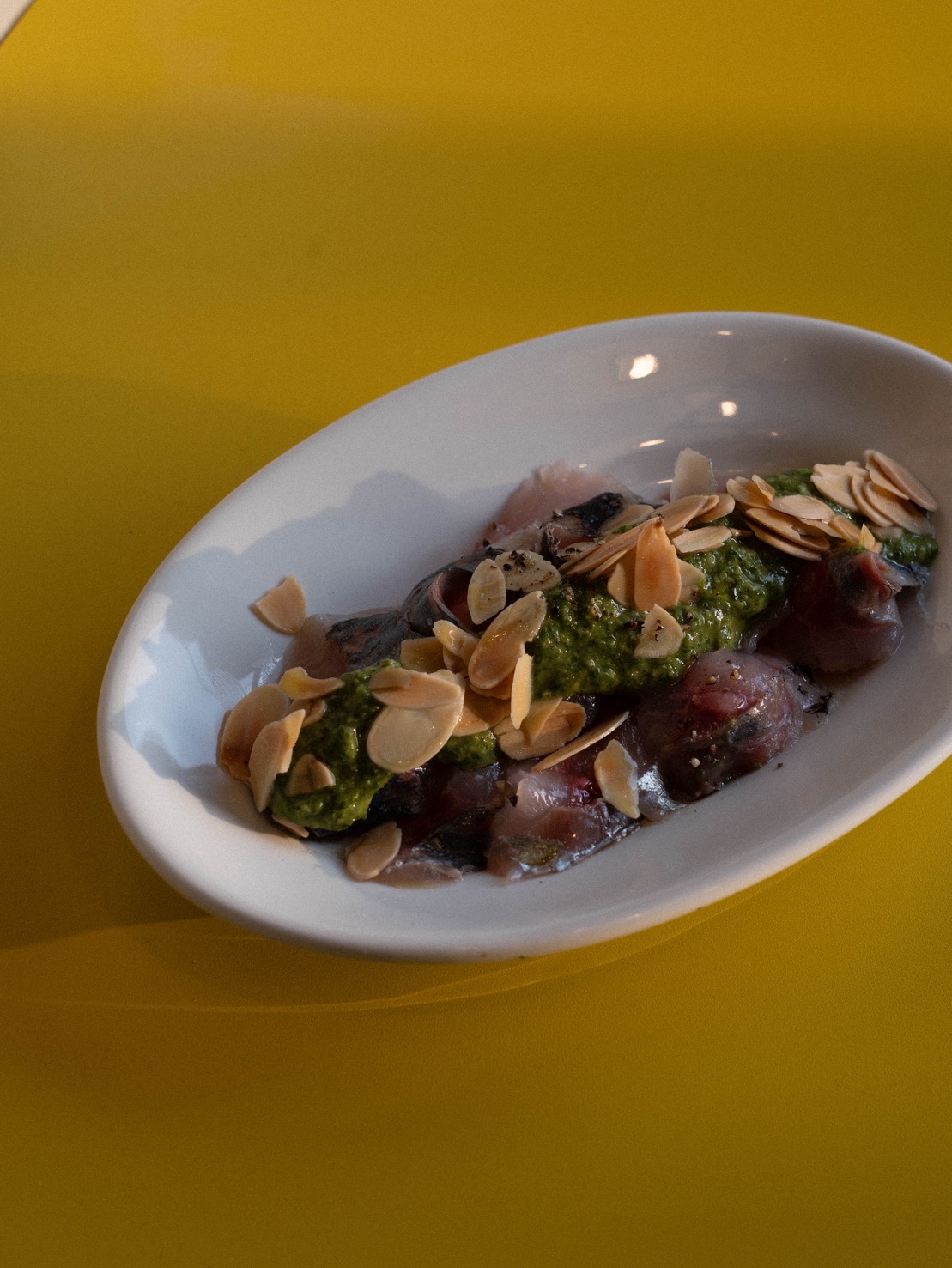
Carpaccio originally meant paper-thin raw beef, born at Harry's Bar in Venice in the 1950s. Walk into any Italian trattoria today, however, and a "Carpaccio di pesce" — fish carpaccio — is almost always on the antipasto list as well. Only the gesture has been preserved: slice something raw, dress it with salt, acid and olive oil. The protagonist itself has shifted from beef to fish, port town by port town across the Mediterranean.
At Bello Vero, the hidden-gem Italian restaurant in Kitashirakawa, Kyoto, the "Fresh Fish Carpaccio" belongs to that fish lineage — with one important condition. The fish itself is not decided until the morning of service. Each day starts with a trip to choose the freshest seasonal fish in person.
Today's Fish Is the Season's Fish — Horse Mackerel or First Bonito
Carpaccio leaves nowhere for the fish to hide. With no cooking, the freshness lands directly on the plate. So the true protagonist of this dish is neither the recipe nor the seasoning — it is whatever fish came in this morning. Bello Vero hand-selects a fresh, seasonal fish each day, which means the same "Fresh Fish Carpaccio" wears a different face every visit.
In this season — late spring into early summer — likely candidates include aji (Japanese horse mackerel) and hatsu-gatsuo (first bonito of the year). Aji brings refined fat and a clean umami; hatsu-gatsuo offers the sharp, light fragrance of an early-season red-fleshed fish. Both are deeply familiar to Japanese eaters — but eaten Italian-style, with salt, acid, a green sauce and olive oil, they become an entirely different dish. There is, beyond soy and ginger, another way to enjoy raw fish; this plate is an introduction to that other path.
A Salsa Verde of Shiso and Parsley
The accompaniment is a green sauce with a Bello Vero twist — a salsa verde of shiso (Japanese perilla) and parsley.
Salsa verde is an old northern-Italian sauce, especially associated with Piedmont, traditionally made by chopping flat-leaf parsley together with capers, anchovies, garlic and olive oil. It is the classic green dressing spooned over boiled meat or fish — simple, with great depth. At Bello Vero, that salsa verde is reworked with the addition of shiso, the Japanese herb. The green of parsley and the bright, distinctly Japanese aroma of shiso layer onto each other, and suddenly the sauce takes on a face that wants to sit beside fish.
Shiso has a particular gift for handling the oils of blue-skinned fish and the perfume of red-fleshed fish. A pure-parsley salsa verde is excellent on its own — but pair it with seasonal Japanese fish like aji or hatsu-gatsuo, and that single layer of shiso lets the inside of your mouth meet the Mediterranean and Japan halfway. A scatter of sliced almonds adds one quiet note of crunch. That is the dish.
Fresh Fish Carpaccio — Shiso & Parsley Salsa Verde, Sliced Almonds
The fish changes daily. In this season, expect aji (horse mackerel) or hatsu-gatsuo (first bonito), depending on the day's catch.
Not Sashimi, Not "Wafu Carpaccio"
Raw fish in Kyoto first conjures sashimi, sushi, or a "wafu" (Japanese-style) carpaccio dressed in ponzu or soy. All of these are wonderful, deeply rooted traditions — but Bello Vero's fish carpaccio sits in a separate place from any of them.
Salt instead of soy. A green sauce of shiso and parsley instead of wasabi. A glass of white or orange wine instead of sake. Guests are often surprised that the same raw-fish material can produce something this different. Eating hatsu-gatsuo dressed with olive oil and salsa verde in particular sketches an outline of flavor that simply does not appear on a Japanese table.
Wines to Pair
Fresh fish carpaccio sits comfortably with light, mineral whites. From northern Italy, a Veneto Soave, a Friulano from Friuli, or a Pinot Grigio from Trentino — wines with bright acidity and restrained oak — are all easy first choices. A mountain-mineral white like Prié Blanc from Valle d'Aosta also leans in beautifully.
The other direction we would push hard is an orange wine. The faint tannin and body drawn from skin contact match the green herbal lift of the salsa verde and the shiso almost perfectly. Blue-skinned and red-fleshed fish like aji and hatsu-gatsuo respond especially well to the skin-derived character of an orange — try it if a white feels not quite enough. Bello Vero keeps a rotating list of freshly arrived natural wines; we will pick a bottle to fit the fish on the night.
Wine is served by the bottle only; Champagne is the sole exception and can be ordered by the glass. A glass of Champagne to start, then a white or an orange for the bottle — an evening that begins with fresh fish carpaccio tends to unfold very comfortably from there.
A Hidden Gem in Kitashirakawa — 15 Minutes on Foot from Ginkakuji
Kitashirakawa is a distinctive corner of Kyoto where the tourist and the local overlap. Walk 10 to 15 minutes north from Ginkakuji along Shirakawa-dori and you are here. It is also within 10 minutes' walk of the northern end of the Philosopher's Path. With Kyoto University and Kyoto University of the Arts just nearby, students and longtime residents have always mingled in these streets.
Most restaurants near Ginkakuji close by 17:00 or 18:00, which leaves late-afternoon travellers without many options for dinner. Bello Vero stays open from 13:00 through 22:00, so the Silver Pavilion or the Philosopher's Path in the afternoon and a relaxed late dinner afterwards both fit into the same day. Drop in as a hidden-gem stop in Kitashirakawa, whether for early wine or a proper evening meal.
The Antipasto Lineup
Alongside the fresh fish carpaccio, Bello Vero also keeps a Beef Carpaccio on the menu. Choose by mood, or by the wine you plan to drink:
- Fresh Fish Carpaccio (Shiso & Parsley Salsa Verde)
- Beef Carpaccio
- Semi-Dried Tomato Caprese
- Carrot Rapé
- Mushroom and New Onion Salad
- Caponata
- Jamón Serrano
- Fried Potatoes with Anchovy Garlic Butter
- Seasonal Vegetable Fritto — 6 kinds
- Homemade Focaccia
Getting Here from Ginkakuji & the Philosopher's Path
After visiting Ginkakuji, head north along Shirakawa-dori and you will arrive in 10 to 15 minutes on foot. From the northern end of the Philosopher's Path it is also within 10 minutes. The nearest bus stop is "Kitashirakawa" (about 2 min on foot), and from Eizan Railway "Chayama · Kyoto University of the Arts" station it is about 10 minutes.
📍 64-17 Kitashirakawa Kubota-cho, Sakyo-ku, Kyoto
🕐 13:00–22:00 (L.O. 21:30) / Irregular closing days
🚶 ~15 min from Ginkakuji / ~12 min from the Philosopher's Path / 2 min from Kitashirakawa bus stop
📅 Reservations: Book online / TableCheck or call +81 75 600 0740