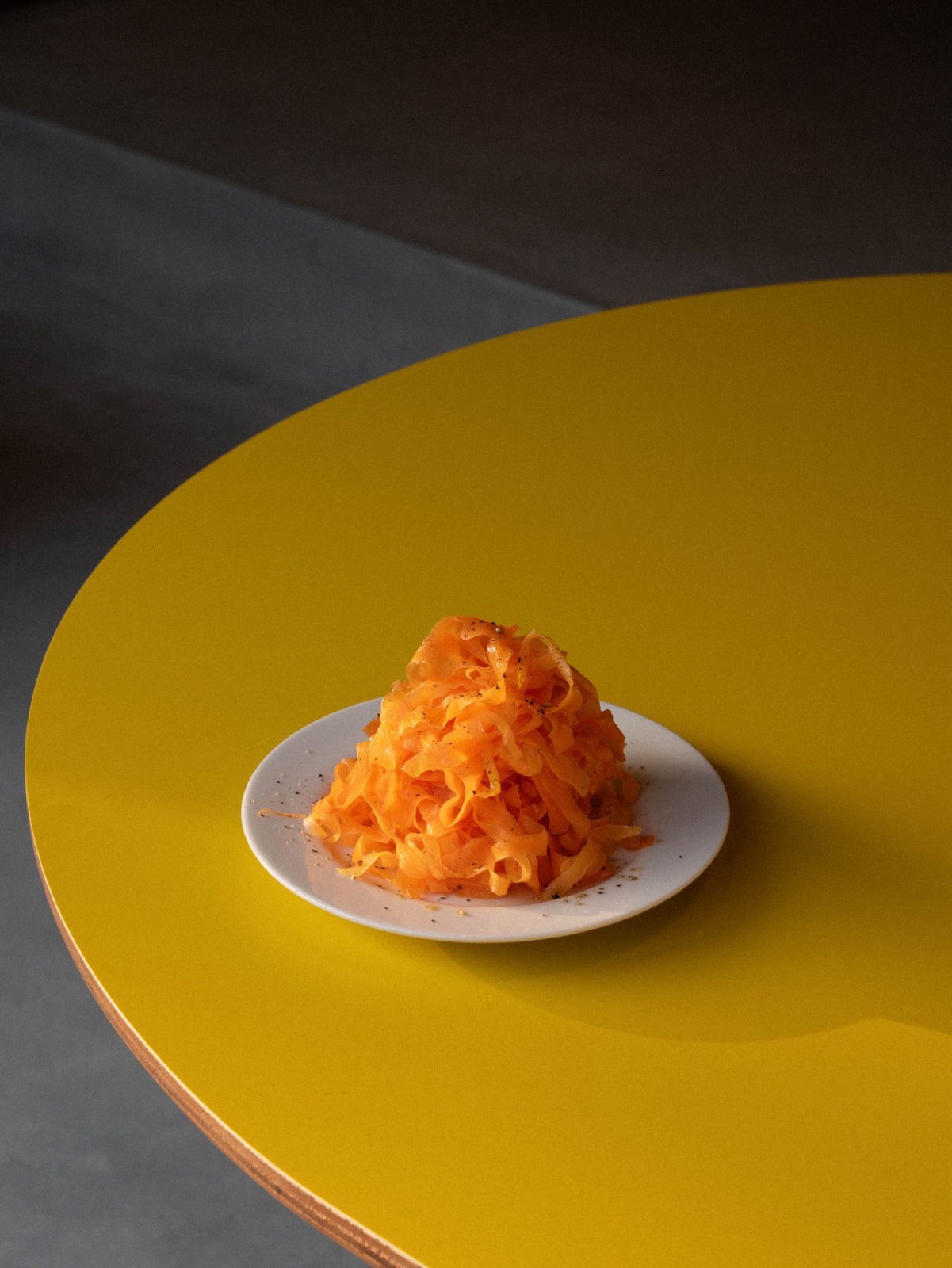
Carrot rapé (carottes râpées) is the grated-carrot salad that turns up everywhere in France — in homes, in bistros, in the chilled cases of traiteurs. Râpées is French for "grated, shaved fine," and that is what the dish is: carrots run through a grater, dressed with lemon juice, olive oil, salt and pepper — and that's the whole of it. In France it is the kind of small plate that always seems to be waiting in a tub at the deli, ready to go.
The carrot rapé on the antipasto list at Bello Vero, our Italian restaurant in Kitashirakawa, Kyoto, follows that line. Finely grated carrots, melded with acid and oil, finished with cracked black pepper — that's the shape of the plate. Piled small and orange in the middle of the dish, it brings a quiet colour to a stripped-back table.
What "Carrot Rapé" Is — A Pillar of French Home Cooking
Ask a French cook about carrots and this is the first thing they think of. Stocked in family fridges, layered into lunchtime sandwiches, holding down one corner of the bistro assiette de crudités — that's how rooted carrot rapé is in everyday French eating. The recipe is almost shockingly short: grate the carrots, hit with acid, bind with oil. Some homes add Dijon mustard and chopped parsley, or swap lemon for white-wine vinegar; others strip the seasoning down to nothing.
For all its plainness, the dish has dimension. The cut of the carrot is the lever: ribbons from a coarse grater, or fine julienne — the mouthfeel changes completely. At Bello Vero the carrots come as soft thin ribbons, salted and lemoned long enough to relax and turn glossy. Each bite leans into the carrot's own sweetness, and the acid wipes the palate clean on the way out.
Bello Vero's Carrot Rapé — A Light First Plate
At Bello Vero we grate the carrots fine, dress them with lemon and olive oil, and finish with salt and freshly cracked black pepper. Piled small on the plate, set on the table — at that point the dish is already done; this is unhurried food. Order it as the partner to the first glass of wine, the easy opening to an evening.
How to eat it is up to you. Forkfuls between sips of wine work; so does laying some on a piece of our freshly baked focaccia, almost as an open-faced vegetable bite. Set next to a slice of salty jamón serrano, the salt-acid-sweetness triangle lifts cleanly.
Carrot Rapé
Finely grated carrots dressed with lemon and olive oil. A quiet, easy plate — the right partner for the first glass of wine.
Why a French Antipasto at an Italian Restaurant?
Bello Vero is an Italian restaurant, and yet carrot rapé is on the menu. The reason is simple: the antipasto culture of Mediterranean Europe doesn't stop at the France–Italy border. Provence in southern France and Piemonte and Liguria in northern Italy share a great deal of culinary grammar across the Alps. Olive oil, raw vegetables, and acid — that triangle sits the same way on the table in Nice, in Genoa, in Sanremo.
Italy has its own long tradition of finely shaved carrot salads dressed with oil and vinegar (carote alla giuliana, insalata di carote). French carrot rapé is, in a way, the same Mediterranean "raw vegetable small plate" rewritten in French, with French home tools. In the same way that Sicily's caponata grew at the edge of the Islamic world, the antipasti of Europe sit shoulder to shoulder with the food of the next country over. Putting carrot rapé on the menu is a quiet nod to that continuity.
A First Plate for the Vegetarian Diner
Carrot rapé is a complete vegetable dish — carrots, lemon, olive oil, salt, black pepper, nothing else. Bello Vero accommodates vegetarian needs on some items and on request, so it can serve as a first plate for a vegetarian guest, or as a cushion before the meat and fish to come. If you have questions about ingredients or preparation, please ask us when you arrive or when you book.
On the same antipasto line, the vegetable-leaning caponata (a sweet-sour stew of aubergine, red pepper, onion and tomato) and the seasonal vegetable fritto — 6 kinds sit nearby. Two or three coloured small plates side by side, and the table opens up.
Wines to Pair — Light Whites, Rosé, Dry Sparkling
Carrot rapé wants a light white wine that takes the carrot sweetness and the lemon acid head-on. The whites of Provence and Languedoc, northern Italian Soave and Friulano, Ligurian Pigato — all carry minerality and orchard-fruit acid that let the carrot's sweetness travel sideways rather than pile up.
Rosé is a happy match here too. The pale rosés of Provence sit in the same orange-to-salmon colour range as the dish, so the pairing reads visually as spring or early summer before you take the first sip. A rosé built on acid and mineral, with subdued fruit, won't tangle with the simplicity of the plate.
For bubbles, dry spumante, crémant, or Champagne. Letting bubbles lift the carrot's sweetness and acidity makes a tidy launching pad for the meal. Wine at Bello Vero is by the bottle only, with Champagne the lone by-the-glass exception. Carrot rapé and a glass of Champagne to open dinner — a small Kitashirakawa luxury that still feels easy.
Beside the Caponata — "Cooked Antipasto" vs. "Tossed Antipasto"
Bello Vero's vegetable antipasti run along two opposing axes. Caponata is the cooked side — aubergine, red pepper, onion and tomato simmered down sweet and tart, in the Sicilian style. Carrot rapé is the tossed side — raw carrot relaxed with acid and oil, in the French style.
Both ride the same vegetable + acid + sweetness triangle, but slow simmering and quick tossing arrive on the palate in completely different orders. Order both alongside a single bottle of wine and the breadth of Mediterranean vegetable cookery quietly spreads itself over the table.
Carrot Rapé in Kyoto
Search "Kyoto carrot rapé" and you turn up French bistros, delis, and a few mail-order purveyors. Kyoto has its share of long-established French restaurants, so carrot rapé itself is not a rare thing in town. What's less common is to find it as a casual small-plate antipasto in the Ginkakuji and Kitashirakawa area. Sitting in this north-eastern corner of Kyoto, a little away from the tourist crush, eating finely grated carrots with a glass of wine — that's one of Bello Vero's small particulars.
In Japan, "carrot salad" usually means the sesame-oil-and-tuna style, or the warm shredded version close to shirishiri. French carrot rapé is neither — it stays with raw carrot, acid, and oil, and finishes there. Its plainness wears well: the seasoning is built on what's removed, not on what's added.
Kitashirakawa, on the Edge of Kyoto — A Hidden Gem 15 Minutes from Ginkakuji
Kitashirakawa is one of those Kyoto corners where the tourist trail and the local neighbourhood overlap. Walk 10 to 15 minutes north from Ginkakuji along Shirakawa-dori and you're here. The northern end of the Philosopher's Path is within 10 minutes on foot. With Kyoto University and Kyoto University of the Arts close by, students and long-time residents have shared these streets for years.
Many restaurants near Ginkakuji close by 17:00 or 18:00, leaving travellers stuck for dinner after the sightseeing is done. Bello Vero stays open from 13:00 to 22:00, so a late dinner after a slow walk along the Philosopher's Path, or a long afternoon glass of wine, both fit. A light visit — just a small plate and a glass of wine — is welcome too.
The Antipasto Lineup
Bello Vero keeps a full antipasto and contorno line around the day's vegetables and fish. Beyond carrot rapé, choose by the mood:
- Caponata
- Seasonal Vegetable Fritto — 6 kinds
- Fried Potatoes with Anchovy Garlic Butter
- Jamón Serrano
- Semi-Dried Tomato Caprese
- Mushroom and New Onion Salad
- Fish Carpaccio / Beef Carpaccio
- Homemade Focaccia
Getting Here from Ginkakuji & the Philosopher's Path
After Ginkakuji, head north along Shirakawa-dori and you arrive in 10 to 15 minutes on foot. From the northern end of the Philosopher's Path it is within 10 minutes. The nearest bus stop is "Kitashirakawa" (about 2 min on foot), and from Eizan Railway "Chayama · Kyoto University of the Arts" station it is about 10 minutes.
📍 64-17 Kitashirakawa Kubota-cho, Sakyo-ku, Kyoto
🕐 Tue–Sun 13:00–22:00 (L.O. 21:30) / Closed Monday
🚶 ~15 min from Ginkakuji / ~12 min from the Philosopher's Path / 2 min from Kitashirakawa bus stop
📅 Reservations: Book online / TableCheck or call +81 75 600 0740