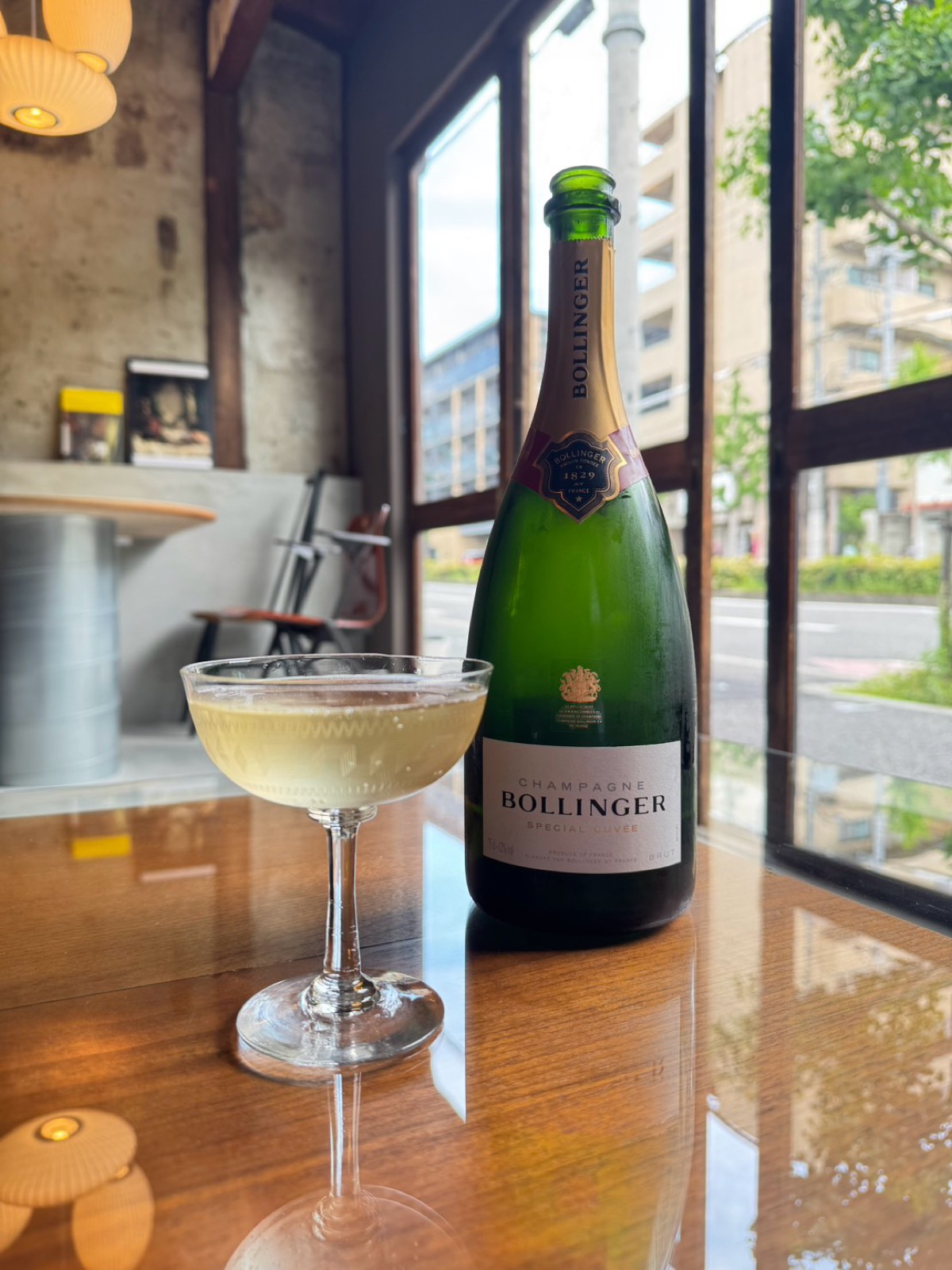
There is exactly one wine on the drinks menu at Bello Vero — our small Italian restaurant in Kitashirakawa — that we serve by the glass. It is our Champagne by the glass. Every other wine on the list, red or white, orange or sparkling, is bottle only. Champagne, though, is the exception. We wanted it to be something you could enjoy from a single glass, without committing to a whole bottle.
The label changes from day to day. That said, the owner has a soft spot for Bollinger, so more often than not, that is what is open behind the counter. Tonight is one of those nights — we are pouring Bollinger Special Cuvée.
A few words about Bollinger
Bollinger is a historic Champagne house, founded in 1829 in the village of Aÿ in the heart of the Champagne region. You will see the date proudly printed on every label. It is one of the few major houses still under family ownership, and it has held a Royal Warrant from the British Royal Family since 1884 — a connection that has lasted well over a century.
Film lovers may also recognise it as James Bond’s Champagne of choice. That recurring scene — "Dom Pérignon or Bollinger" — comes from an official partnership between 007 and Bollinger that has now run for more than fifty years.
What makes the wine distinctive comes down to two things: it is built around Pinot Noir, and the first fermentation is done in small oak barrels — a method that is rare in Champagne today. The result is a sparkling wine with unusual depth: rich fruit, toast, and notes of nuts and brioche, all riding on sharp, fine bubbles. It has more weight than the bright, weightless style of Champagne you might be used to.
Bollinger by the glass — a quiet luxury
Honestly, pouring Bollinger by the glass at our by-the-glass price is something of a stretch on our side. Champagne by the glass has become more common around town, but once you start choosing the label too, it gets harder to keep things this approachable.
The reason we offer it at this price is not complicated. The owner simply wanted guests to be able to enjoy a really good Champagne, by the glass, without thinking too hard about it. Not every evening calls for opening a bottle. Some nights you just want a small celebration, or a clean, bright glass to start with while you wait for someone, or a moment of crispness before dinner. This pour is for those evenings.
The coupe — another quiet pleasure
The other thing we would like to mention is the shape of the glass itself. What we pour into is a coupe — the shallow, wide-mouthed, stemmed glass that has almost disappeared from modern restaurants.
Today, Champagne is usually served in a tall, narrow flute, or more recently in a tulip shape closer to a white wine glass. These shapes make sense: they hold the bubbles longer and concentrate the aromas.
So why did the coupe disappear? The answer is interesting, because the coupe is in fact the traditional vessel for Champagne, from the 17th century all the way to the 1960s. The Champagne towers you have seen in old films — Victorian England, Belle Époque Paris, post-war Hollywood — are all built from coupes.
Back then, Champagne was the drink of royalty and the upper classes — Versailles, the salons of 19th-century aristocrats, the first-class lounges of the great ocean liners. The shallow, wide bowl on its slender stem was the glass that ladies and gentlemen lifted for a toast. Even the gesture of holding it up — palm cradling the bowl — was part of the ritual.
The flute only became standard in the second half of the 20th century. On purely technical grounds, it is the rational choice — better for bubbles, better for aromas — and almost every restaurant now uses one. But beyond rationality, there is something else. When you want to treat Champagne not as a drink but as a special glass to slow down with, the coupe still feels right. Lean over its wide opening and Bollinger’s deep, layered aroma unfolds all at once. Watching the bubbles rise across that saucer-shaped surface is, in itself, a small luxury.
Food pairings — from light starters to richer plates
Because Bollinger Special Cuvée is a rich, Pinot Noir-driven Champagne, it is unusually flexible — it pairs with almost anything on the menu, which is rare for a sparkling wine.
- On its own, as an aperitif — the sharp acidity and complex aroma reset the palate beautifully.
- Jamón Serrano and other cured hams — bubbles cut through the salt and fat in the classic Champagne-and-charcuterie way.
- Beef carpaccio / Fish carpaccio — minimal lemon-and-olive-oil starters that lean into the Champagne’s brightness.
- Vegetable fritto / Fried potatoes with anchovy-garlic butter — the acidity and bubbles slice through the oil of fried food with ease.
- Just-baked focaccia with olive oil — the toasty notes from the oak fermentation echo the warm bread.
- Lampredotto and Salsiccia — even richer meat dishes hold up against the weight of Bollinger.
From aperitif through to the courses before dessert, a single glass of a richer Champagne like this can carry the whole meal. That is one of the pleasures of a wine with this kind of depth.
Champagne is the only wine we serve by the glass.
The bottle changes daily; Bollinger Special Cuvée is open more often than not, but it depends on what we have opened that evening.
All other wines (red, white, orange, sparkling) are served by the bottle only. Feel free to ask at the counter about anything that catches your eye.
Come to Kitashirakawa for tonight’s glass
After a walk around Ginkaku-ji or the Philosopher’s Path, head a short way south along Shirakawa-dori and you will find us. We are a two-minute walk from the "Kitashirakawa" city bus stop, and about a fifteen-minute walk from Ginkaku-ji. We are open Tuesday through Sunday, from 1 p.m. straight through to 10 p.m. — so whether it is a quiet early evening or a late-night nightcap, you can start with a glass of Champagne.
Let the day’s walk unwind slowly, bubbles rising in a coupe.
📍 Kitashirakawa Kubota-cho 64-17, Sakyo-ku, Kyoto
🕐 Tue–Sun 13:00–22:00 (L.O. 21:30) / Closed Monday
2 min from Kitashirakawa city bus stop / about 15 min on foot from Ginkaku-ji
📅 Reservations via Web booking / TableCheck or phone 075-600-0740