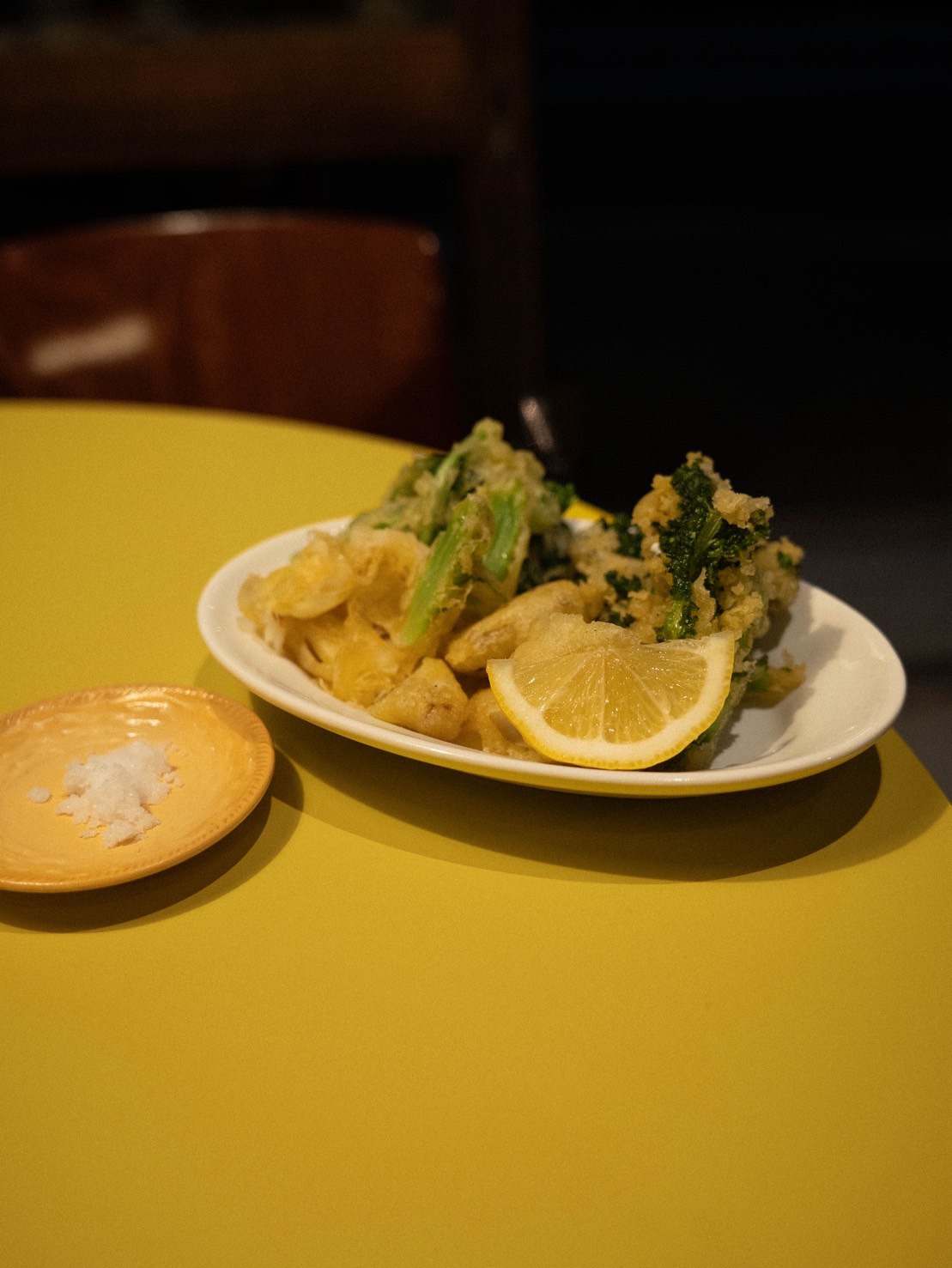
The Italian fritto is, in a way, a distant cousin of Japanese tempura — but lighter, looser, less ceremonial. The batter is thin, the oil sometimes carries olive oil in the blend, and what comes out of the fryer is not the deep gold of tempura but a paler, dusted, almost snow-touched colour. Romans call it fritti misti, Venetians frittura, the Genoese frisciö; every region of Italy has its own name and its own habits for the fryer.
At Bello Vero, the hidden-gem Italian restaurant in Kitashirakawa, Kyoto, the dish on the menu reads simply "Seasonal Vegetable Fritto — 6 kinds." No sauce. Just flour, lemon, and a small dish of salt.
"Six Kinds" — Whatever Came in That Day
The line says "six kinds" precisely because it isn't fixed. Broccoli, rapeseed flowers, asparagus, new spring onions, zucchini, baby corn, lotus root, purple sweet potato, eringi mushrooms, maitake — out of that kind of pool, six are picked according to whatever looked best that morning. Some days the plate skews green, some days it leans earth-brown with roots and mushrooms.
From late spring into early summer — right now — the line-up tends towards broccoli and rapeseed stems, the woody base of asparagus, wedges of new spring onion, young baby corn, broad beans, and a wild mushroom. In winter it is mostly roots; come summer, zucchini blossoms and sweet Manganji peppers slip in.
The Batter — Thin, Light
An Italian fritto batter does not coat the way tempura does. It is a loose mix of flour with a little water (or beer, or sparkling water) — just enough to glaze the vegetable, never to wrap it. You can see the outline of the asparagus or broccoli through the crust. That thinness is the whole idea.
The oil is hot, the dip in the fryer short. Greens like broccoli and rapeseed flowers come out while their colour is still vivid; lotus root and roots take a slower, deeper turn to bring out their sweetness. The pace is set vegetable by vegetable, then the six are gathered onto the plate together.
Lemon and Salt, Nothing Else
No sauce is made. The plate arrives with a wedge of fresh lemon and a small dish of coarse salt. That is all.
How you eat it is entirely up to you. Squeeze the lemon directly, or take the first bite with salt only and the next with lemon, swinging the flavour back and forth. Eaten hot, while the aroma is still rising — that is the whole way the dish is meant to behave on the table, and it tends to disappear quickly.
Seasonal Vegetable Fritto — 6 kinds
Whatever vegetables came in that day. Same plate served all day, lunch through dinner.
Set Beside the Fried Potatoes
Bello Vero also serves a Fried Potatoes with Anchovy Garlic Butter. Same fryer, two very different roles. The fried potatoes are pre-seasoned — anchovy, butter, rosemary — built to grab the first sip of wine. The vegetable fritto leaves the seasoning to you: more lemon and it pulls towards a spring antipasto, more salt and it leans into white wine. Two antipasti that play off each other are the natural way to open a meal here.
Searching "Kyoto Fritto"
Search "Kyoto fritto" in Japanese and the first results are takeaway potato kiosks at Kyoto Station or the Daimaru basement — fried in a paper cup, eaten while walking. That is a fine kind of fun.
What is harder to find in Kyoto is the other kind: a fritto eaten seated, on a plate, next to a glass of wine. Especially "six seasonal vegetables, whatever came in that day" — that level of fritto is rare even in this city. Bello Vero's vegetable fritto sits at the start of a meal, not in your hand on the street.
Wines to Pair, and Afternoon Drinking
A clean, mineral-driven white is the most natural fit. Sicilian Grillo or Catarratto, Soave from the Veneto, Friulano from Friuli — bottles that meet the lemon without flattening the vegetables. Sparkling wines are also strong: a dry Franciacorta or Prosecco, even Champagne, cuts through the fryer's oil with bubbles.
Wine is served by the bottle only; Champagne is the sole exception and can be ordered by the glass. A late afternoon, just back from Ginkakuji or the Philosopher's Path, with a glass of Champagne and the vegetable fritto — a very reasonable place to start drinking in the daylight.
Vegetarian-Friendly on Some Items
"Seasonal Vegetable Fritto — 6 kinds" is built from batter, oil, vegetables, salt, and lemon. No animal products are involved, so it is an easy first plate for guests skipping meat or fish. If you have any questions about ingredients or preparation, please feel free to ask on arrival or when you reserve. Bello Vero accommodates vegetarian requests on some menu items.
A Hidden Gem in Kitashirakawa — 15 Minutes on Foot from Ginkakuji
Kitashirakawa is a corner of Kyoto where the tourist trail and the local neighbourhood overlap. Walk 10 to 15 minutes north from Ginkakuji along Shirakawa-dori and you are here. The northern end of the Philosopher's Path is also within 10 minutes' walk. With Kyoto University and Kyoto University of the Arts just nearby, students and long-time residents have always mingled in these streets.
Most restaurants near Ginkakuji close by 17:00 or 18:00, leaving travellers nowhere to eat after dark. Bello Vero stays open from 13:00 to 22:00, so the Silver Pavilion in the afternoon and a relaxed late dinner afterwards fit the same day. Drop in as a hidden-gem stop in Kitashirakawa, whether for early wine or a proper evening meal.
The Antipasto Lineup
Bello Vero keeps a full antipasto and contorno list. Beyond the vegetable fritto, order whichever fits the mood:
- Seasonal Vegetable Fritto — 6 kinds
- Fried Potatoes with Anchovy Garlic Butter
- Semi-Dried Tomato Caprese
- Carrot Rapé
- Mushroom and New Onion Salad
- Caponata
- Jamón Serrano
- Fish Carpaccio / Beef Carpaccio
- Homemade Focaccia
Getting Here from Ginkakuji & the Philosopher's Path
After visiting Ginkakuji, head north along Shirakawa-dori and you arrive in 10 to 15 minutes on foot. From the northern end of the Philosopher's Path it is within 10 minutes. The nearest bus stop is "Kitashirakawa" (about 2 min on foot), and from Eizan Railway "Chayama · Kyoto University of the Arts" station it is about 10 minutes.
📍 64-17 Kitashirakawa Kubota-cho, Sakyo-ku, Kyoto
🕐 Tue–Sun 13:00–22:00 (L.O. 21:30) / Closed Monday
🚶 ~15 min from Ginkakuji / ~12 min from the Philosopher's Path / 2 min from Kitashirakawa bus stop
📅 Reservations: Book online / TableCheck or call +81 75 600 0740