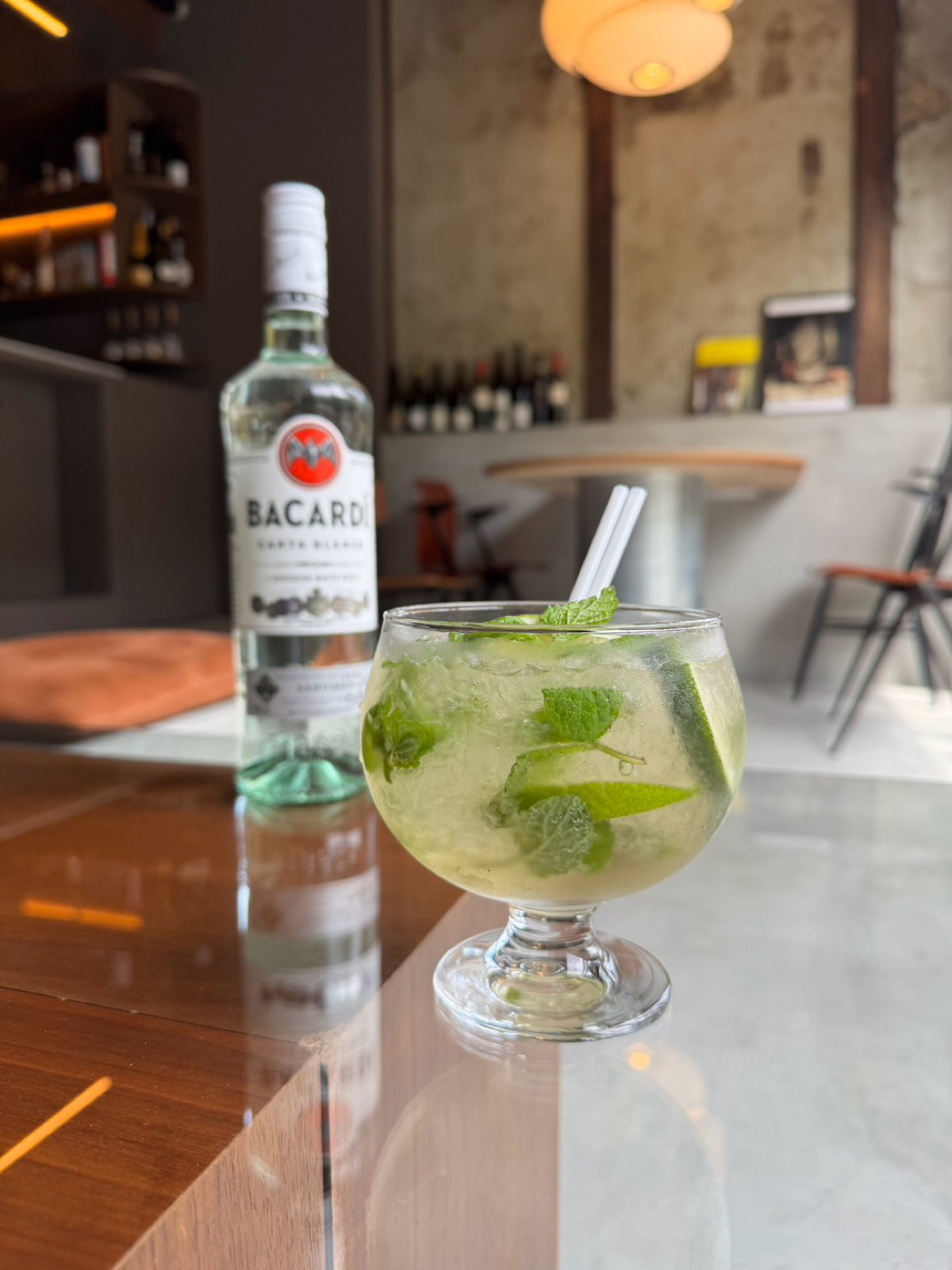
By mid-May, walking through Kyoto already brings a thin film of sweat. The light lingers longer along the Kamogawa and the Philosopher's Path, and the slow opening into evening becomes the loveliest hour of the day.
On an evening like that, if a guest asks us at the counter for "something cool to start," there is only one answer at Bello Vero, our little Italian place in Kitashirakawa: the mojito.
A few minutes across the counter
When the order is placed, the chef reaches first for the ice.
The glass is not pre-filled. A mojito here begins with ice being cracked on the spot into rough, crushed pieces. The dry kann, kann of the cracking carries through the room in the early evening — and more than a few guests have told us that the moment they hear it, they feel summer has finally arrived.
Next, fresh mint is torn by hand, generously, and dropped into the glass. No knife — a blade bruises the fibres and pulls out a needless bitterness. Tearing is the rougher, more honest work, and it is what releases the brightest aroma. Even the chef's fingertips smell green for a moment.
Lime is cut into wedges and squeezed in. A spoon of cane sugar follows. Then a measure of Bacardi white rum is poured over the top.
And then the chef takes up the pestle. Gently, gently, the mint is pressed — not crushed. Press it too hard and the leaves turn bitter; the idea is only to coax out the perfume. It is more "lean on it" than "pound it." The green scent climbs steadily up through the glass.
Soda last, a single soft stir, two straws, and the glass is set on the counter.
From start to finish, only a few minutes. Those few minutes, spent right in front of you — that is how we serve a mojito here.
Why we wait to build it
A mojito is one of those cocktails where the first few minutes are the most beautiful ones.
The green burst the moment a leaf is torn, the cool lift the moment the pestle presses down, the citrus pop the moment soda meets the lime — every one of these is an aroma that fades slowly inside the glass. Of course we could muddle a batch of mint ahead of time and pour faster. But the best part of the drink would already be gone by the time it reached you.
So we ask for a little patience. The sound of the ice, the green air spreading through the room, the chef's quiet profile as he watches the glass — if you're sitting at the counter, we hope you'll let that "waiting time" be part of the mojito itself.
What's in the bottle: Bacardi Carta Blanca
The rum we pour is Bacardi Carta Blanca, the famous bat-logo bottle — one of the most recognised white rums in the world.
Its home is Cuba, which also happens to be the home of the mojito. In 1862, in a small still in Santiago de Cuba, a man named Facundo Bacardí set out to make rum — at the time a rough, fiery spirit — into something lighter and easier to mix. He aged it in oak, then filtered it slowly through charcoal until it ran clear. What comes out is clean, light and unassertive, and it lets the mint and lime rise without arguing with them.
A Cuban rum for a Cuban cocktail. No grand theory behind it — just the simple, warm truth that things that belong together really do belong together. That is why this rum sits behind our counter.
Served in a generous stemmed glass
One last thing worth mentioning: the glass.
Most people picture a mojito in a tall highball. We use something different — a generous stemmed glass, a rounded bowl on a foot, closer in shape to a cognac or wine glass.
The reason is simple. The crushed ice, the torn mint leaves and the lime wedges scatter beautifully across that wider bowl. Green and clear spread out side by side, and the drink already looks cool before you've taken the first sip.
The two straws are another small touch — so the last mouthful is as easy to reach as the first.
What it loves on the plate, and what it doesn't
The mojito leads with mint and lime — a subtractive kind of freshness. Set against a heavy red-meat dish or a cream-based pasta, both sides lose. But paired with the right small plates, a mojito makes an early-summer dinner feel twice as good.
- Fish carpaccio with salsa verde — the green sauce and the green of the mint paint a single picture
- Carrot rapé — the lemon-and-olive-oil lightness sits easily alongside the mojito's cool
- Caponata — the sweet-sour vegetable starter unexpectedly mirrors the mojito's sugar-and-acid balance
- Jamón Serrano — the salt and fat are cut cleanly by mint and lime
- Fried potatoes with anchovy garlic butter / Vegetable fritto — soda and lime slice through the oil of anything fried
Of course, it works on its own too, as the first drink of the evening. As the crushed ice slowly melts, the flavour softens and the aroma keeps opening up — a cocktail you drink along with the time, perfect for a slow, drifting evening.
Because the mojito is built only after you order, it takes a little longer than other drinks.
In exchange, it reaches you with the mint aroma at its brightest.
On a warm evening like this one, it makes a lovely first glass at the counter.
A glass to open the Kyoto summer
After a walk through Ginkaku-ji and the Philosopher's Path, head a little south along Shirakawa-dori and you'll find us. Two minutes on foot from the city bus stop "Kitashirakawa," about fifteen minutes from Ginkaku-ji. Open Tuesday to Sunday, 1pm straight through to 10pm — whether you arrive early in the evening or late at night, you can begin with a mojito.
Let the start of the Kyoto summer open with mint and lime.
📍 Kitashirakawa Kubota-cho 64-17, Sakyo-ku, Kyoto
🕐 Tue–Sun 13:00–22:00 (L.O. 21:30) / closed Mondays
2 min on foot from city bus stop "Kitashirakawa" / about 15 min from Ginkaku-ji
📅 Reservations: Online booking / TableCheck or phone 075-600-0740