In Florence, the city in central Italy, there is a layer of cooking that has nothing to do with the postcard image of the place — dishes that locals have eaten in their daily life for generations. The most emblematic of them is sold from corner street-stalls called Trippaio (tripe vendor), and its name is Lampredotto.
Lampredotto is a Florentine tradition: beef tripe — specifically the abomasum, the fourth stomach — slowly simmered until tender with aromatic vegetables, lifted with herbs, and traditionally tucked into a round bun to eat standing up. It rarely turns up on tourist menus, yet for the people of Florence it has long been a default lunch — that is the place this dish occupies.
At Bello Vero, the Italian restaurant in Kitashirakawa, Kyoto, lampredotto is on the Secondo (main course) list as a plate clarified with white wine. No tomato is used; the dish is built only from white wine and the sweetness of aromatic vegetables, simmered patiently — light on the stomach, never heavy after the meal, and yet leaving the unmistakable satisfaction of having eaten a proper braise.
Florentine Street-Stall Flavor, Set on a Plate
Lampredotto was originally a workers' lunch. Around the central market of Florence and its surrounding streets, the Trippaio stalls are still there, lifting steaming tripe out of huge pots and tucking it into a round panino bun. A spoon of salsa verde (green parsley sauce) or salsa piccante (a hot chili sauce) goes on top, and you eat it standing up — that is the original way.
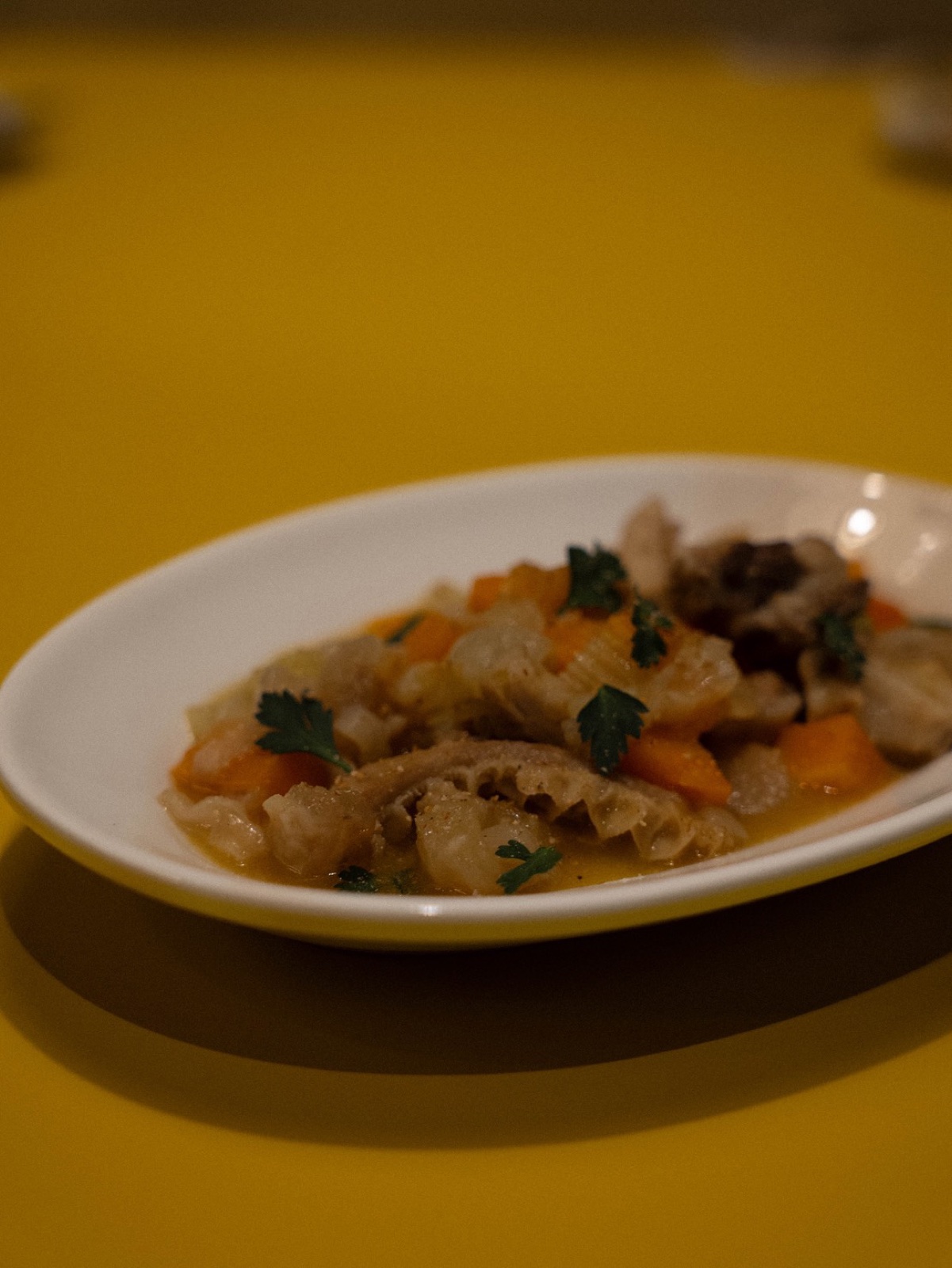
Bello Vero's plate translates that street-stall flavor onto a dish. Instead of bread, the tripe arrives in its broth, eaten with a spoon. Carrot, onion and celery are simmered alongside, and at the very end Italian parsley is added to lift the aroma. A fragrant white-wine broth carries the umami of the tripe and the gentle sweetness of the vegetables, clear all the way through.
White Wine Instead of Tomato — A Lighter Choice
"Tripe stew" in Japan tends to mean miso, soy sauce or a tomato base, finished into something dense. In central Italy, however, there is also a long-standing technique of simmering tripe purely in white wine, clarified rather than thickened. Without tomato's sharp acidity or color, the umami of the tripe itself and the delicate sweetness of the aromatic vegetables rise through unmasked.
That is the version Bello Vero serves, for a simple reason: it is light enough to sit beside the wine. A heavy braise is hard to follow with pasta or dolce. A plate clarified in white wine, by contrast, can be placed right in the middle of a course that started with antipasto without slowing the rhythm. And yet the gelatinous texture of the tripe, with its distinctive bite, is fully preserved — that is where this dish reveals its depth.
For Anyone Who Thought They Did Not Like Tripe
If you have ever said "I'm not really a tripe person," lampredotto is exactly the dish to try. With careful preparation and a slow simmer in white wine and aromatics, the so-called "off" notes are completely cleaned out. What remains is a soft, gelatinous mouthfeel and a savory depth that grows the more you chew — a kind of "tripe deliciousness" that has nothing in common with Japanese yakiniku innards or motsu-nabe.
The food culture of central Italy is built on a deep-rooted principle: "there is no part to discard; use everything" — this is the tradition known as quinto quarto (the "fifth quarter," the offal cooking of the butchered animal). Lampredotto is its emblem, and the centuries Florentines have spent perfecting "how to make offal the protagonist" are right there on the plate.
Lampredotto — Beef Tripe Braised in White Wine
Slowly clarified with carrot, onion and celery in white wine, finished with a scatter of Italian parsley.
Wines to Pair
A white-wine-clarified lampredotto sits well with a lighter red, or with an orange wine that carries a touch of tannin. A Sangiovese-based, medium-bodied red — Chianti from Tuscany, the home region of Florence — recreates the pairing actually drunk at the street-stalls. The white wine in the braise and the soft tannin of Sangiovese pull each other into focus.
The other direction we love is an orange wine. The faint tannin from skin contact and the structure drawn from the grape skins support the depth of the braise from underneath. If you enjoy natural wine, please try this combination. Bello Vero rotates Italian natural wines as new shipments arrive, so we will pick a bottle from that night's list.
Wine is served by the bottle only; Champagne is the sole exception and can be ordered by the glass. Start with a glass of Champagne over the antipasto, then a red or an orange for the bottle — an evening built around lampredotto becomes its own small, complete course.
Kitashirakawa, on Kyoto's Quiet Edge — A Hidden Gem 15 Minutes from Ginkakuji
Kitashirakawa is a distinctive corner of Kyoto where the tourist and the local overlap. Walk 10 to 15 minutes north from Ginkakuji along Shirakawa-dori and you are here. It is also within 10 minutes' walk of the northern end of the Philosopher's Path. With Kyoto University and Kyoto University of the Arts just nearby, students and longtime residents have always mingled in these streets.
Most restaurants near Ginkakuji close by 17:00 or 18:00, which often leaves travellers hunting for a place to have dinner after sightseeing. Bello Vero stays open from 13:00 through 22:00, so a relaxed late dinner after Ginkakuji and the Philosopher's Path — or an early-afternoon glass of wine — both fit comfortably into the same day. Drop in as a hidden-gem stop in Kitashirakawa, and have the flavor of a Florentine street-stall — lampredotto — at the quiet edge of Kyoto, with a bottle of wine.
Contorno e Secondo — Sides and Mains
Alongside lampredotto, the main-course list at Bello Vero includes salsiccia, steak, grilled American eggplant and more. Choose by mood — a braise, a grill, or something fried — from the lineup of the day:
- Lampredotto (Beef Tripe Braised in White Wine)
- Ginkakuji Onishi Kuroge Wagyu Steak 150g
- Sautéed Salsiccia with Mashed Potato
- Grilled American Eggplant with Bolognese Sauce
- Vegetable Frittata (Italian Omelette)
- Fried Potatoes with Anchovy Garlic Butter
- Seasonal Vegetable Fritto — 6 kinds
Getting Here from Ginkakuji & the Philosopher's Path
After visiting Ginkakuji, head straight north along Shirakawa-dori and you will arrive in 10 to 15 minutes on foot. From the northern end of the Philosopher's Path it is also within 10 minutes. The nearest bus stop is "Kitashirakawa" (about 2 min on foot), and from Eizan Railway "Chayama · Kyoto University of the Arts" station it is about 10 minutes.
📍 64-17 Kitashirakawa Kubota-cho, Sakyo-ku, Kyoto
🕐 13:00–22:00 (L.O. 21:30) / Irregular closing days
🚶 ~15 min from Ginkakuji / ~12 min from the Philosopher's Path / 2 min from Kitashirakawa bus stop
📅 Reservations: Book online / TableCheck or call +81 75 600 0740