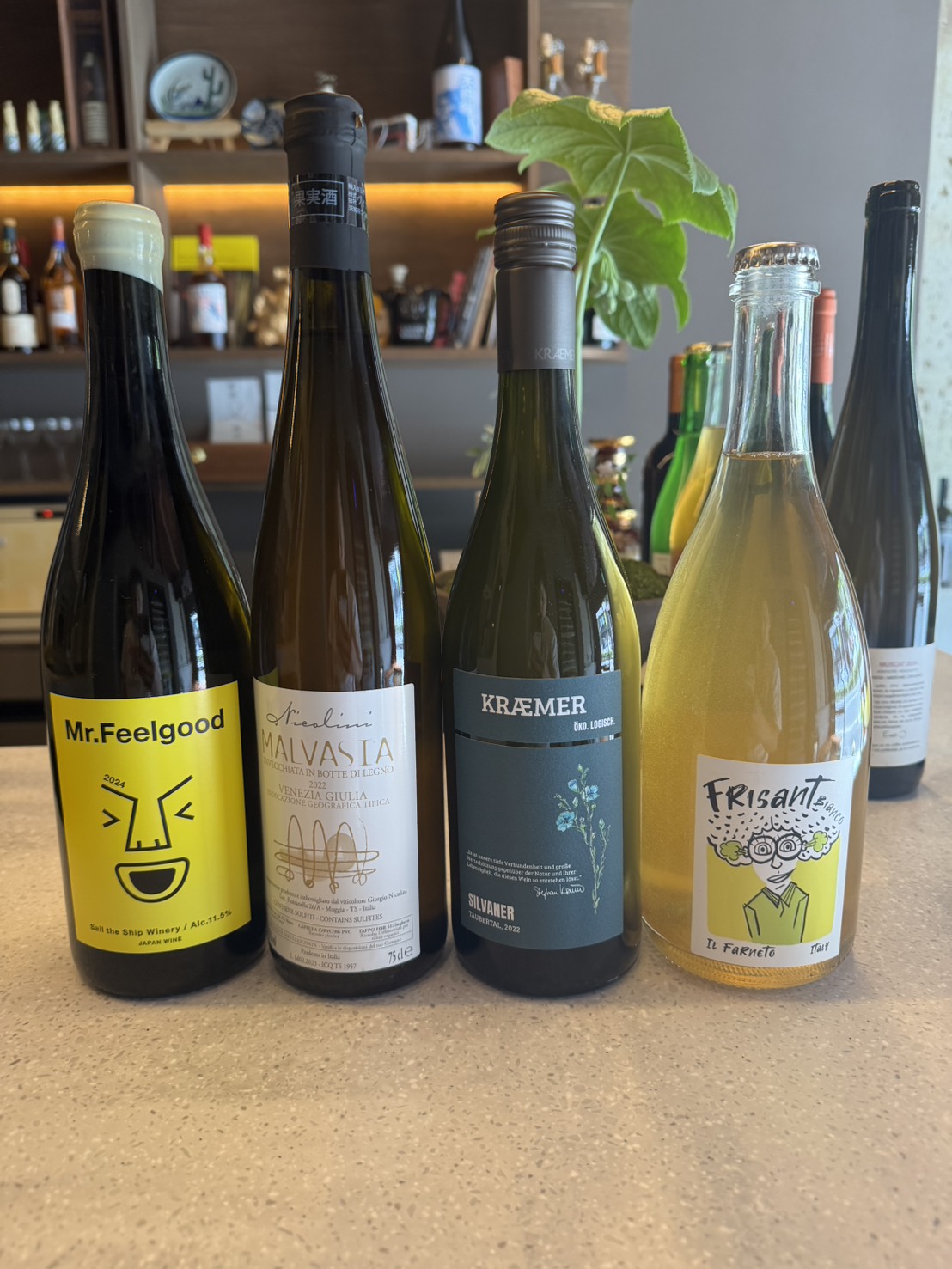
Four new white wines have just landed at Bello Vero, the Italian restaurant in Kitashirakawa. One from Japan, two from Italy, one from Germany. Different countries, different grapes — and yet all four share the same thread: native varieties and minimal intervention. Natural wine, biodynamic, organic — the labels differ, but in each case the grower tries to keep their hand as light as possible, in the vineyard and the cellar, so that the voice of the land reaches the bottle intact.
Let us introduce them, one by one.
Bottle 1 | Mr.Feelgood White 2024 (Sail the Ship Winery / Nagano)
A brand-new winery in the Higashiyama district of Ueda, Nagano, at 550 m of altitude on a gently south-facing slope. 2024 is their very first vintage — a producer still being born.
The blend: Chardonnay 71%, Petit Manseng 17%, Romorantin 7%, Chenin Blanc 3%, Roussanne 2%. A so-called "field blend" — whatever is planted in the row is picked together and vinified together. Fermentation happens with native yeasts from the grape skins alone. No additives.
The wine tastes the way it is named: feel good. Unpretentious, gentle fruit, with a whisper of fizz still left behind. Japan's wine scene has clearly graduated from "imitating Europe" — here is a bottle speaking in its own voice, from its own soil. The front line.
Pour it at the opening of a meal. It sits beautifully next to light starters like salsiccia crostini or caprese — the soft fruit and light prickle cut through pork fat and mozzarella cream. A true opener.
Bottle 2 | Nicolini Malvasia 2022 (Friuli-Venezia Giulia / Italy)
Italy's easternmost corner, a breath away from the Slovenian border. Looking down onto the Adriatic sits the town of Muggia, where Giorgio Nicolini tends a small vineyard. He works the old-fashioned way his grandparents taught him, replanting from a hundred-year-old massal selection, protecting the grapes of this coast.
The grape is Malvasia Istriana — the same lineage as the Croatian Istrian peninsula across the bay, a seaside variety through and through. Grown on marine clay soils, the juice is macerated on its skins for 48–60 hours, then aged 8–12 months in oak. Only around 1,500 bottles were made of the 2022 vintage — genuinely scarce.
Faintly golden in the glass. On the nose, white flowers, ripe pear, and a salty mineral lift — the faint salt memory of grapes grown by the sea.
The skin-contact body is too full for light seafood; it matches much better with a red-meat raw dish. Try it with wagyu carpaccio or prosciutto. The saline mineral runs in the same direction as the cured salt, and the oak ageing echoes the sweetness of lean meat. A white for the richer end of the antipasti.
Bottle 3 | KRÆMER Silvaner Taubertal 2022 (Franken / Germany)
From the Franken region of Germany, the valley of the Tauber (Taubertal). German white wine brings Riesling to mind first, but Franken's lead grape is Silvaner. Less showy than Riesling, it is the grape that mirrors the minerality of its soil honestly — understated, sincere.
The producer, Ökologischer Weinbau Krämer, has farmed organically (Naturland-certified) since 1990. The label proudly reads "ÖKO. LOGISCH." — "organic, logically" — and that sums up their stance. In the cellar, too, additives are kept to the minimum; a tiny dose of sulphites only just before bottling.
Green apple, pear, citrus, and herbs on the palate. A clear mineral backbone, acidity that runs long and clean.
That sharp acidity slices cleanly through the oil of vegetable fritto, and the citrus-and-mineral aromatics settle next to the wheat and ferment of our freshly baked focaccia. It also picks up the salt of the hard cheeses on a cheese plate. A genuine all-rounder — the white to sit in the middle of the table.
Bottle 4 | Il Farneto Frisant Bianco (Emilia-Romagna / Italy)
To close: a slightly playful, lightly sparkling white. In the village of Castellarano, between the hills of Scandiano and Canossa in Emilia-Romagna, sits Il Farneto — an eight-hectare winery started by Marco Bertoni in the mid-1990s. The vineyards are worked biodynamically, and only natural wines are made here.
Grapes: 80% Spergola, the local native, and 20% Sauvignon Blanc. The method is Metodo Ancestrale — not the Champagne route of adding sugar for a second fermentation, but the older technique of bottling mid-fermentation, letting the wine finish inside the bottle. This is, essentially, the forebear of today's Pét-Nat.
Unfiltered, so lightly cloudy, a soft straw colour. Pull the cap and orange-blossom and baker's-yeast aromas rise with the soft mousse.
Bubbles have a special power — they punctuate a meal. As an aperitivo, they set the evening's conversation in motion. Mid-meal, they fit beautifully with our salsiccia and lemon pasta — lemon acidity meets fresh fizz. And at the end, try it with strawberry semifreddo: the bubbles reset the dairy fat of the dolce in a single sip.
All four bottles are offered by the bottle only.
Aside from Champagne by the glass (¥2,000), we pour these wines only by the full bottle.
Stock changes daily — feel free to ask at the counter.
How We Choose Our Wines
Our list runs across red, white and orange, with bottles from Japan and several European countries. Rather than chasing prestige labels, we build toward wines that make you think "this is the bottle to pour with tonight's dish" — a list that answers the kitchen.
Natural, biodynamic, conventional — we lean none of the three too far. Natural is not automatically virtuous, and sometimes a classic bottle is simply the right answer tonight. Ask at the counter — "what should I drink tonight?" — and we will suggest according to the dish and your mood.
The Role Each Bottle Plays
Put another way, each of the four has a place at the table:
- Mr.Feelgood White — the easy opener (carries off the fat of light starters).
- Nicolini Malvasia — for the richer antipasti (echoes the salt and savour of cured and raw red meat).
- Krämer Silvaner — the all-rounder for the centre of the meal (acidity cuts through fat, minerality frames the dish).
- Il Farneto Frisant Bianco — to punctuate, before and after (bubbles reset both conversation and palate).
Rather than trying to taste all four in a single evening, pick the one that sits closest to tonight's dish and tonight's mood. Ask us at the counter and we will pair it with what you have on the plate.
An Evening of Europe, from Kitashirakawa
Bello Vero is in Kitashirakawa, a 10–15 minute walk north up Shirakawa-dori from Ginkakuji, and within 10 minutes of the northern end of the Philosopher's Path. We serve straight through from lunch to dinner, so it is easy to drop in on the way back from sightseeing.
From a single counter in Kyoto, listen to Nagano, to Friuli, to Franken, to Emilia — four lands, side by side. A luxury measured not in labels, but in the slow hour it takes to finish a bottle.
📍 64-17 Kitashirakawa Kubota-cho, Sakyo-ku, Kyoto
🕐 13:00–22:00 (L.O. 21:30) / Irregular closing days
2 min from "Kitashirakawa" bus stop / about 15 min from Ginkakuji
📅 Reservations: Book online / TableCheck or call +81 75 600 0740