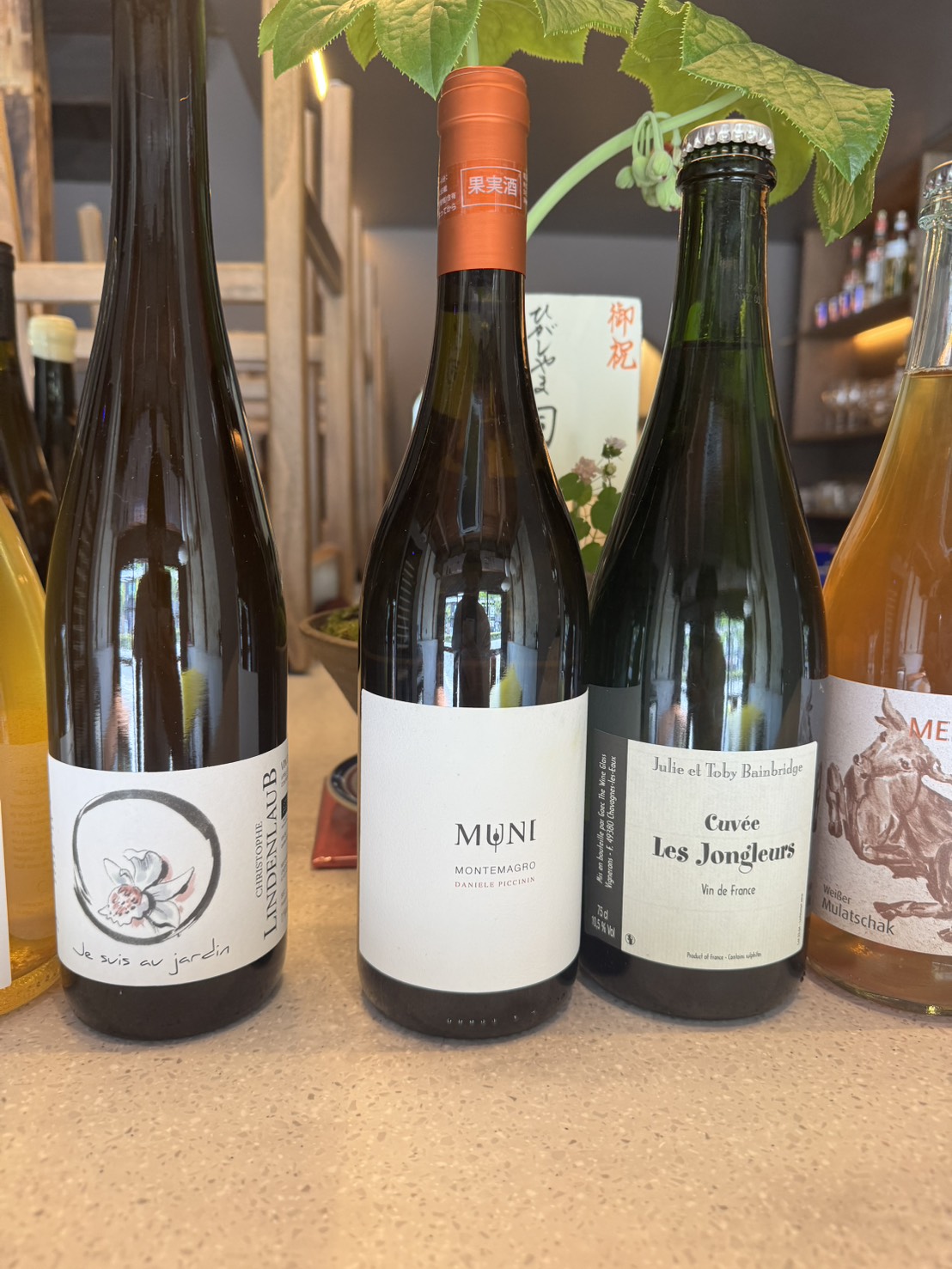
Three new white wines have just arrived at Bello Vero, the Italian restaurant in Kitashirakawa. Two from France, one from Italy. Alsace, Veneto and the Loire — three different vineyards, three different grapes, three different ways of working. What binds them is a single thread: native varieties and minimal intervention. Natural, biodynamic, organic — each grower keeps their hand as light as possible so the voice of the land reaches the bottle intact.
Let us introduce them, one by one.
Bottle 1 | Christophe Lindenlaub "Je suis au jardin" (Alsace / France)
From Dorlisheim in the Bas-Rhin, northeastern France. Domaine Lindenlaub dates back to 1759; Christophe, the fourth generation, took over from his father in 1999. He converted the vineyards to organic in 2009, and the cellar to natural winemaking in 2012. Unfiltered, almost no added sulphites — one of Alsace's more radical growers.
The blend: two-thirds Muscat Ottonel, one-third Muscat d'Alsace. Harvested from clay soils, macerated on the skins for around three weeks, then fermented and aged slowly in stainless steel. The long skin contact gives a pale golden-to-slightly-orange hue — white on paper, but carrying the touch of a light skin-contact wine.
On the nose: mandarin peel, orgeat (almond syrup), white flowers. All the aromatic generosity of Muscat, held in check by the structure and acidity the skins provide. "Je suis au jardin" — "I am in the garden" — and the bottle does feel like a spring garden in full bloom, layered and expressive.
Pour it at the start of a meal, next to caprese or spring vegetable fritto. The aromatic lift meets tomato, basil and young greens; the faint tannin from the maceration cuts through fried oil. A bottle that opens the table, from aperitivo into the antipasti.
Bottle 2 | Daniele Piccinin "Montemagro" (Veneto / Italy)
San Giovanni Ilarione, in the province of Verona. At the foot of the Monti Lessini, an alpine foothill range, Daniele Piccinin works his vineyard. Vice president of VinNatura, he is a leading voice in Italian natural wine. The rows are left to grow mint, plantain and alfalfa — a fully living cover — and copper and sulphur are held to the bare minimum.
The grape: Durella, 100%. Grown in the Monti Lessini for more than a thousand years, now close to extinction. "Montemagro" is a selection from sixty-year-old vines in the best parcel, fermented and aged in large casks of Slavonian and French oak, then given further bottle age before release.
Durella is, in the grower's own words, "a grape that refuses to be controlled." Its heart is a piercing, bright acidity. Green apple, citrus, chalky mineral, a whisper of salt. Not showy, but straight-backed — the kind of white that makes you sit up.
That acidity meets the lemon and salt of a seafood carpaccio or a wagyu tagliata without any effort. Equally good with fritti or a pasta of spring vegetables. A white for the middle of the meal, through antipasti into pasta — a craftsman's bottle that rewards the long haul.
Bottle 3 | Julie et Toby Bainbridge "Cuvée Les Jongleurs" (Loire – Anjou / France)
"Vin de France" on the label, a crown cap on top — it looks vaguely Champenois, but the vineyard is in fact on the Loire, in Anjou. Toby (British) and Julie (American) Bainbridge moved to the Loire and farm about 8.5 acres of Chenin Blanc, Cabernet Franc and Grolleau — a relatively young project, and a deeply committed one.
"Les Jongleurs" — the jongleurs, the wandering medieval entertainers — is Chenin Blanc, 100%. Two parcels, sandy and quartz, blended and aged in concrete. Hand-picked, direct-pressed, wild yeast, only the tiniest dose of sulphites. Bottled unfiltered, with a gentle natural fizz held in.
The Champagne bottle and crown cap are practical — no risk of cork taint, and a clear glass to show the colour. In the glass: Chenin's yellow peach, pear, chamomile, honey. Damp-stone mineral. A light prickle of gas that passes quickly across the tongue.
That light fizz is a punctuation mark. It works as the first aperitivo of the evening, beside a chicken in cream sauce or a grill mid-meal, and next to something light like strawberry semifreddo at the end. Less formal than Champagne, less fizzy than a Pét-Nat — a comfortable middle ground. The jongleur's name fits: a bottle with a little play in it.
All three bottles are offered by the bottle only.
Aside from Champagne by the glass (¥2,000), we pour these wines only by the full bottle.
Stock changes daily — feel free to ask at the counter.
How We Choose Our Wines
Our list runs across red, white and orange, with bottles from Japan and several European countries. Rather than chasing prestige labels, we build toward wines that make you think "this is the bottle to pour with tonight's dish" — a list that answers the kitchen.
Natural, biodynamic, conventional — we lean none of the three too far. Natural is not automatically virtuous, and sometimes a classic bottle is simply the right answer tonight. Ask at the counter — "what should I drink tonight?" — and we will suggest according to the dish and your mood.
The Role Each Bottle Plays
Put another way, each of the three has a place at the table:
- Lindenlaub "Je suis au jardin" — the opener (aromatic lift to launch the antipasti).
- Piccinin "Montemagro" — the middle of the meal (sharp acidity and mineral to carry seafood, spring vegetables and antipasti).
- Bainbridge "Les Jongleurs" — the punctuation (a light fizz that works from aperitivo to main to a light dolce).
Rather than trying to taste all three in a single evening, pick the one that sits closest to tonight's dish and tonight's mood. Ask us at the counter and we will pair it with what you have on the plate.
An Evening of Europe, from Kitashirakawa
Bello Vero is in Kitashirakawa, a 10–15 minute walk north up Shirakawa-dori from Ginkakuji, and within 10 minutes of the northern end of the Philosopher's Path. We serve straight through from lunch to dinner, so it is easy to drop in on the way back from sightseeing.
From a single counter in Kyoto, listen to Alsace, to Veneto, to the Loire — three lands, side by side. A luxury measured not in labels, but in the slow hour it takes to finish a bottle.
📍 64-17 Kitashirakawa Kubota-cho, Sakyo-ku, Kyoto
🕐 13:00–22:00 (L.O. 21:30) / Irregular closing days
2 min from "Kitashirakawa" bus stop / about 15 min from Ginkakuji
📅 Reservations: Book online / TableCheck or call +81 75 600 0740