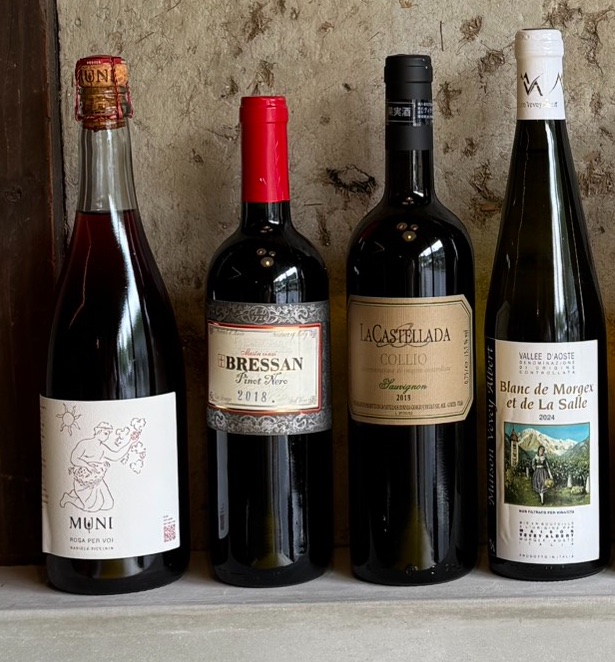
Four new wines have arrived at Bello Vero, the Italian restaurant in Kitashirakawa, Kyoto. This time, all four are Italian — and if you trace them on a map, they move steadily westward across the north of the country: Veneto → Friuli Venezia Giulia → Valle d'Aosta. A sparkling rosé to open, a mature white, a structured red, and finally a crystalline alpine white to close — a lineup that can carry an entire meal from first sip to last.
Here is each bottle, in turn.
1. Daniele Piccinin "Rosa per Voi" (Veneto, Italy)
As in our previous journal entry, we begin with Daniele Piccinin, one of the pioneers of natural wine in Veneto's Monti Lessini. This sparkling rosé, bottled under his MUNI label, is the wine we have in mind today.
The blend is Pinot Noir and Durella, drawn from the musts of his top cuvées "Kalipè" (Pinot Noir, aged in wood) and "Epochè" (Durella, aged in steel). The wine is made by the metodo classico (traditional method of bottle refermentation) and rests on the lees for 24 months or more before being disgorged with zero dosage. Unfiltered.
The name "Rosa per Voi" — "a rosé for you" — was born of a question from Piccinin's daughter Edda: "Papà, why don't you make a rosé for us too?" It is not a showpiece sparkler; it's a bottle meant to be shared on a summer evening, without ceremony.
Pale salmon with a fine, persistent mousse. The nose is wild strawberry, rose, a whisper of brioche from the lees, citrus peel. The classic-method texture is delicate, held upright by Durella's taut acidity. A superb aperitivo, wonderful with focaccia, jamón serrano or a seafood carpaccio — the wine that opens the table.
2. La Castellada "Collio Sauvignon 2015" (Friuli, Italy)
From Veneto we move east, almost to the Slovenian border, into Oslavia — the tiny village in Friuli Venezia Giulia's Collio DOC that sits at the heart of the modern orange-wine movement. Gravner, Radikon, Primosic, Princic and, alongside them, La Castellada — all neighbours who, from the late 1990s onward, revived the ancient practice of fermenting white grapes on their skins.
La Castellada was founded by Giuseppe Bensa; since 1985 it has been run by his sons Giorgio and Nicolò, with roughly 10 hectares under organic cultivation.
This bottle is 100% Sauvignon Blanc — but set aside every cliché of the grape. Destemmed fruit ferments spontaneously in open-top Slavonian oak vats with about four days of skin contact (a light "orange" brushstroke rather than a long Ribolla-style maceration), then the wine ages for roughly two years in wood, with extra time in bottle before release. Unfiltered.
At roughly eleven years old, the 2015 is fully mature. Deep gold in the glass, with yellow stone fruit, dried herbs, beeswax, tea leaf and flint. On the palate the "green" varietal signature has receded, replaced by salinity, umami, and the slow, tertiary complexity of a wine that has been waiting patiently.
A Sauvignon that does not want a plain fillet of fish — it wants prosciutto and Parmigiano, porcini risotto or pasta, vitello with lemon and capers, or herb-roasted white meat. Umami-rich dishes that would overwhelm a conventional Sauvignon sit beautifully here. Serve at 12–14 °C to let the aromatics open.
3. Bressan "Pinot Nero 2018" (Friuli, Italy)
We stay in Friuli but drop down onto the Isonzo plain, to the village of Farra d'Isonzo. Bressan Mastri Vinai was founded in 1726 — three centuries and nine generations of the same family, today in the hands of Fulvio Bressan. No synthetic fertilisers, no herbicides, no chemical sprays; dry-farmed, estate fruit only. An old-school house in the best sense.
The wine is 100% Pinot Nero (Pinot Noir), fermented with native yeasts on the skins for about thirty days, then aged in used 20-hL wooden casks for three to four years — an uncommon length even in Burgundy — followed by several months in stainless and further rest in bottle. Alcohol is 13.5%.
In the glass, a translucent ruby with violet edges. The nose unfolds layer by layer: wild blackberry, raspberry, spice, cocoa, and an ethereal, almost balsamic lift. The palate is fresh-fruited but genuinely structured, with silky tannins and a long, elegant finish. Not a modern, fruit-forward Pinot but a classical, Burgundian silhouette — a wine that has been made by time.
Pair with wagyu tagliata, roasted veal shaved with truffle, duck and game birds, porcini or black-truffle pasta, and aged hard cheeses. A red that is ready to face the savoury, forest-floor middle and main courses of the evening head-on.
4. Ermes Pavese "Blanc de Morgex et de La Salle 2024" (Valle d'Aosta, Italy)
Our final bottle takes us to Italy's far north-west, to the Valle d'Aosta, on the border with France and Switzerland. At the foot of Mont Blanc, at 900–1,200 metres of altitude, lie some of the highest vineyards in Europe. This is the home of Ermes Pavese, tucked into the hamlet of La Ruine between the villages of Morgex and La Salle.
The grape is Prié Blanc — an indigenous Valle d'Aosta variety planted almost nowhere else. More remarkable still: the vines are grown on their own roots, ungrafted. Phylloxera, the aphid that devastated European vineyards in the late nineteenth century, never reached this altitude on the sandy, glacial soils. Training is pergola; the terraced dry-stone walls climbing the slopes are a landscape of their own.
Vinification is entirely in stainless steel, to preserve the alpine freshness. No wood. Alcohol sits around 11.5–12% — a featherweight wine with a steel spine.
In the glass, nearly water-pale. The nose is alpine herbs and tiny white flowers, green apple, pear (Williams), lemon peel, and a whisper of white-pepper spice over crushed stone. The palate is piercing in its acidity, saline on the finish, and gratifyingly light. A wine that doesn't tire you out.
Pair with raw fish and crudo, oysters and shellfish, simple herb-and-salt antipasti, or alpine cheeses (fontina, toma). It works equally well as an aperitivo, as a palate-cleanser mid-meal, or as a light, refreshing close to the evening.
All four bottles are available by the bottle only.
(The only wine by the glass at Bello Vero is Champagne, ¥2,000.)
Stock moves daily — please ask at the counter when you visit.
The role each bottle plays
To summarise, each wine has its own place at the table:
- Piccinin "Rosa per Voi" — the opener (fine classic-method bubbles for aperitivo and antipasti)
- La Castellada "Sauvignon 2015" — the middle (mature, umami-rich, for antipasti through risotto and mushroom dishes)
- Bressan "Pinot Nero 2018" — the red for the main course (game, wagyu, truffle, aged cheese)
- Pavese "Blanc de Morgex 2024" — the light, clear white (seafood, shellfish, alpine cheese, a gentle close)
You don't need to drink all four in a single evening — choose the one that fits tonight's dishes and your mood. If you ask at the counter, we can recommend a bottle to go with the dishes you've ordered.
Travelling northern Italy in a single night
Plot these four bottles on a map and they form a clean west-bound line across northern Italy: from the Lessini hills above Verona, east to the Friulian border country and the Isonzo plain, then all the way west to the Mont Blanc foothills. Different climates, different soils, different altitudes — four distinct voices, heard at a single counter.
Bello Vero sits in Kitashirakawa in the north-east of Kyoto — a 10–15 minute walk north along Shirakawa-dori from Ginkakuji, and about ten minutes from the northern end of the Philosopher's Path. We stay open straight through from lunch into dinner, so it is easy to stop in for a glass or a bottle on the way home from a day of sightseeing.
How we choose our wines
Our wine list is organised by colour — red, white, orange, sparkling — and draws on bottles from Japan and across Europe. The aim is less to line up famous labels than to make sure there is always a bottle that wants to be drunk with tonight's dishes.
Natural, biodynamic, conventional — we lean in no single direction. A natural bottle is not automatically the right one; sometimes a classical wine is. Ask at the counter — tell us what you've ordered, or what kind of evening you're in the mood for, and we'll suggest something that fits.
📍 64-17 Kubotacho, Kitashirakawa, Sakyo-ku, Kyoto
🕐 13:00–22:00 (L.O. 21:30) / Irregular closing days
2 min walk from "Kitashirakawa" bus stop / about 15 min walk from Ginkakuji
📅 Reservations: Book online / TableCheck or call +81 75 600 0740