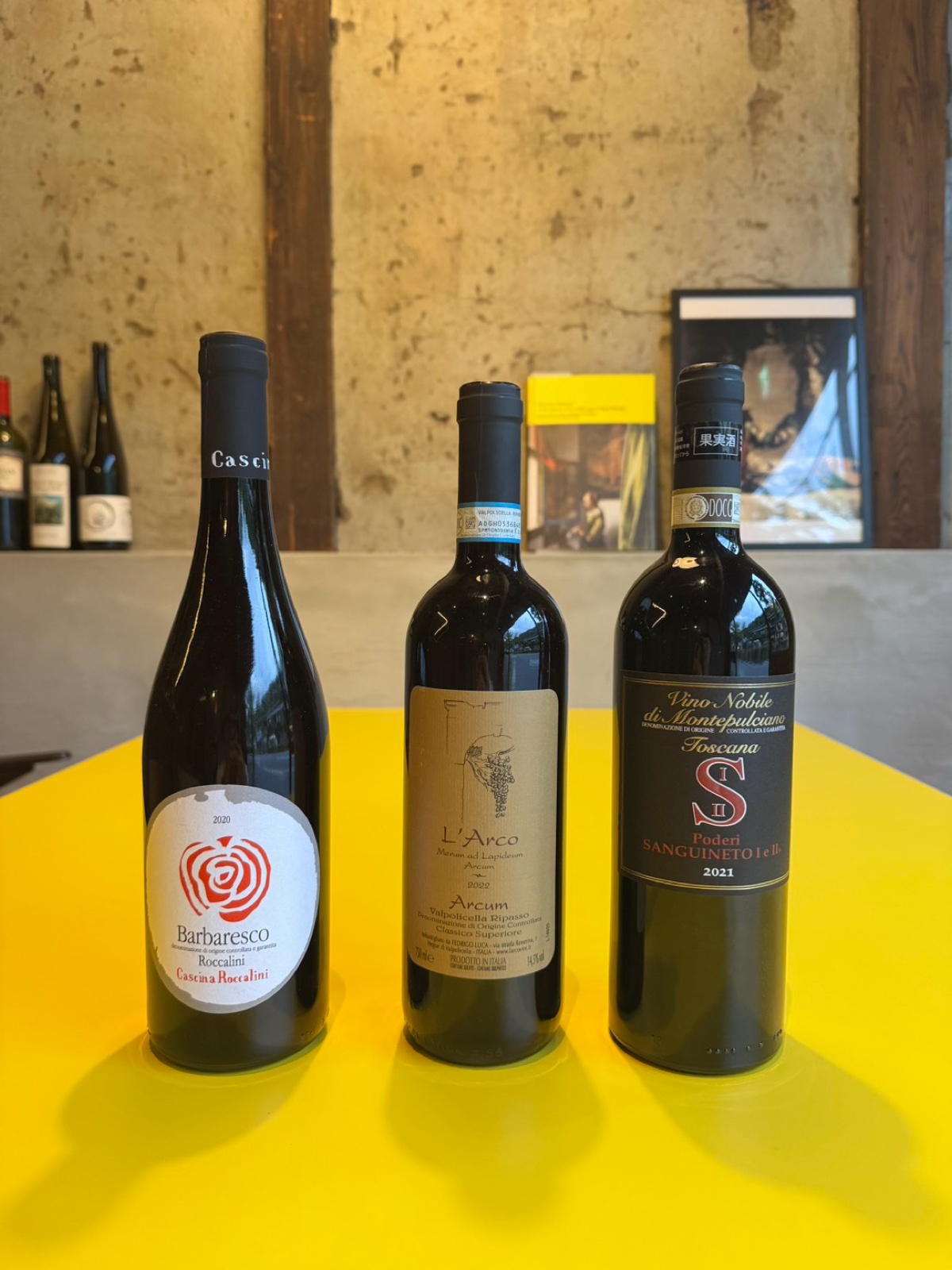
Three new red wines have just arrived at Bello Vero, the Italian restaurant in Kitashirakawa, Kyoto. Each comes from a different region, a different grape, and a different way of working — one bottle each from Piedmont, Veneto, and Tuscany.
Draw a single line down the Italian peninsula from north to centre, and these three bottles map almost perfectly onto the great "holy lands of red wine" along the way. Allow me to introduce them in turn.
Bottle One | Cascina Roccalini "Barbaresco Roccalini 2020" (Piedmont / Italy)
The first bottle comes from one of the very summits of Italian red wine: Barbaresco DOCG. The producer is Cascina Roccalini, a tiny family-run micro-winery with vineyards in the village of Barbaresco, Piedmont. Owner Paolo Veneroso tends only what his own hands can reach, and annual production is minuscule. Which is exactly why a bottle arriving at the restaurant is something to celebrate.
His vineyards are concentrated within a cru (single vineyard area) called "Roccalini" — the same name proudly inscribed on the label. The soils are limestone and clay, the oldest vines exceed fifty years, and the farming follows a natural approach without recourse to conventional chemistry. Aging takes place in traditional large oak casks (botte grande) so that new oak never overpowers the wine. This is classical Langhe winemaking through and through.
The grape, of course, is 100% Nebbiolo — a variety named after the Piedmontese fog (nebbia), and one of the oddest creatures in the vine world: pale in colour, yet fierce in tannin and acidity. Compared to its neighbour Barolo, Barbaresco is generally said to be more aromatic and more supple.
2020 was a warm, generous, easy-natured vintage for Piedmont. Roccalini\'s 2020 pours a garnet-tinged ruby in the glass. The nose is a textbook of Nebbiolo — a bouquet of roses, dried cherry, black tea, dried herbs, and beneath them tar (coal tar) and liquorice. On the palate, the fruit is surprisingly juicy, and underneath spreads silk-fine tannin. Acidity is precise, the finish long; the wine is still young, but already drinking beautifully.
Pair it with roast wagyu beef, mushroom risotto or pasta (especially porcini or black truffle), roast duck or pigeon, or aged cheese. It clings to aromatic dishes built on deep umami broths. Serve it at 16–18°C in a large Burgundy-shaped glass, and let it open slowly — this is a bottle to spend an evening with.
Bottle Two | L\'Arco "Arcum" Valpolicella Ripasso Classico Superiore 2022 (Veneto / Italy)
The second bottle comes from Valpolicella in Veneto, made by the natural producer L\'Arco — a micro-winery in the Valpolicella Classico district run by owner Luca Fedrico. The vineyards lie near San Pietro in Cariano, and the label still carries the maker\'s own address — "imbottigliato da Federico Luca - via strada Ravarina" — engraved as part of the design.
Valpolicella reds are traditionally organised into four tiers: Valpolicella, Ripasso, Amarone, and Recioto. The bottle that just arrived is a Ripasso — sometimes nicknamed the "baby Amarone of Valpolicella" — a uniquely styled wine that sits in the middle of that hierarchy.
The technique is distinctive: a regular Valpolicella is fermented first, and is then "passed again" over the still-fragrant grape skins (vinaccia) left behind from pressing Amarone. That second pass — ripasso literally means "passed again" — transfers a portion of Amarone\'s fruit weight, tannin, and complexity into the wine. The result is a "best-of-both-worlds" style: the freshness of Valpolicella crossed with the power of Amarone.
"Arcum" is L\'Arco\'s upper Ripasso, drawn from the heartland vineyards entitled to call themselves Classico Superiore. The blend follows the traditional Valpolicella recipe — Corvina, Corvinone, and Rondinella as the backbone, with a small addition of indigenous local varieties. The alcohol sits at 14.5%, hinting at the firm structure you can already read off the label.
In the glass, deep garnet. The nose offers dried cherry, prune, raisin, cocoa, dried herbs, and notes of violet and black pepper underneath. The Ripasso\'s concentrated fruit coexists with the clean reduction and earthy register typical of natural wine. On the palate, lighter than its colour would suggest — fine-grained tannin, well-defined acidity, a finish marked by bittersweet chocolate and the residual sweetness of dried fruit. This is no muscle wine; it is a "Ripasso that wins you over with aromatics".
Pair it with pasta bolognese, salsiccia and bean stew, lampredotto (Florentine tripe), duck or wild boar ragù, or medium-aged cheese such as pecorino. It marries beautifully with slow-cooked, braised dishes, and is a particularly reliable companion in cold weather. Serve at 16–18°C in a medium-bowl red wine glass.
Bottle Three | Poderi Sanguineto I e II "Vino Nobile di Montepulciano 2021" (Tuscany / Italy)
The third bottle comes from Montepulciano in Tuscany, made at a tiny estate run by two sisters: Poderi Sanguineto I e II. The owners are the Castagnola sisters, Dora and Patrizia. The "I e II" in the name means "first cellar and second cellar" — each sister tends her own vineyard and her own cellar, and the two streams are then bottled under a single shared label.
The vineyards lie within a very small zone in the village of Montepulciano. The work in the vines is almost entirely by hand, without recourse to conventional farming; in the cellar, traditional Tuscan large oak casks (botte grande) are used, and the winemaking deliberately avoids over-extraction. Quietly adored by sommeliers around the world, Sanguineto is one of Tuscany\'s great "hidden classics".
The wine\'s formal appellation is Vino Nobile di Montepulciano DOCG — alongside Brunello di Montalcino and Chianti Classico, one of the three peaks of Tuscan red wine. The grape is Prugnolo Gentile — the local Tuscan clone of Sangiovese — joined in small proportions by indigenous varieties such as Canaiolo and Mammolo.
2021 was a classically balanced vintage for Tuscany. Sanguineto\'s 2021 pours a luminous, transparent ruby. The nose carries cherry, pomegranate, violet, dried herbs, black tea, and beneath them the scent of old Italian wooden floorboards — that slightly damp, warm-earth note. On the palate, the bright, defined acidity typical of the Sangiovese family forms the spine; the fruit is moderate, the tannin tightly woven and slightly fine-grained. This is the kind of red "you don\'t tire of, that wants to sit alongside the food rather than compete with it".
Pair it with Tuscan-style bistecca (grilled beef), tagliata of Chianina beef, pappardelle with wild boar ragù, tomato and bean stew, or Pecorino Toscano. It hugs Tuscan cooking most closely, but it also matches surprisingly well with Japanese dishes built around roast lean meats and umami-driven simmered preparations. Serve at 16–18°C in a medium to large-bowl glass.
All three of the wines introduced above are served by the bottle only.
The only by-the-glass wine at Bello Vero is sparkling Champagne (¥2,000); reds, whites, and orange wines are bottle-only.
Stock changes day by day — please feel free to ask at the counter when you visit.
Three Regions, Three Reds — Why These Three Together?
The three bottles that just arrived trace a route from the misty hills of Barbaresco in northern Italy, down through the Valpolicella hills outside Verona, and on to the ancient Tuscan town of Montepulciano — a single evening\'s journey down the Italian peninsula from north to centre.
- Cascina Roccalini "Barbaresco 2020" — Nebbiolo. Aromatic, with silk-fine tannin. Roses, cherry, black tea. The "wine that pulls a long finish out of pure aromatics".
- L\'Arco "Arcum" Valpolicella Ripasso 2022 — A Corvina-led blend. Concentrated fruit, cocoa, and the clean reduction of natural winemaking. The "midfield protagonist for slow-cooked dishes".
- Poderi Sanguineto "Vino Nobile 2021" — Prugnolo Gentile. Translucent ruby, with an acid-driven backbone. The "red that wants to sit beside the food".
All three are bottle-only, so choose what suits the size of your party, the dishes you order, and the rhythm of the evening. Sanguineto with the antipasti and middle of the meal, Arcum with the mains, and Roccalini at the end alongside the cheese — that, of course, is also a perfectly indulgent way to do it.
How We Choose Our Wines
Our wine list is organised by colour — red, white, orange, sparkling — and stocked with bottles from Japan and across Europe. We balance natural, organic, and conventional producers without leaning too far in any single direction. Natural isn\'t automatically better; sometimes a classic bottle is the best match for tonight\'s dish. Just ask at the counter — "What would go well today?" — and we\'ll suggest something to suit the food and your mood.
📍 Kitashirakawa Kubotacho 64-17, Sakyo-ku, Kyoto
🕐 Tue–Sun 13:00–22:00 (L.O. 21:30) / Closed Mondays
2 min on foot from "Kitashirakawa" city bus stop / about 15 min walk from Ginkakuji
📅 Reservations via Online Booking / TableCheck or by phone at 075-600-0740