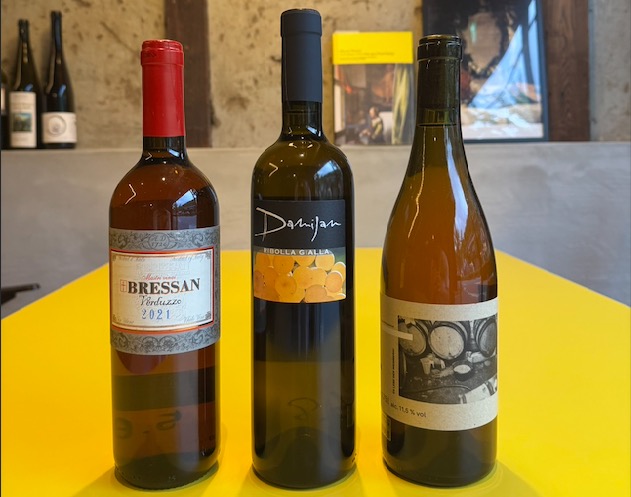
New wine has arrived at Bello Vero, the Italian restaurant in Kitashirakawa, Kyoto. Both bottles this time come from Friuli-Venezia Giulia — Italy's easternmost region, a small province sharing its border with Slovenia. Friuli has long been celebrated as a "holy land of white wine," captivating the world with aromatic whites such as Pinot Grigio and Ribolla Gialla.
And in recent years, Friuli has become known for another face: skin-contact whites — the lineage of what we now call orange wine. Producers like Gravner and Radikon began here, fermenting white grapes on their skins for extended periods like a red wine. Today, that approach has become a north star for natural winemakers across the world.
The two bottles that just arrived express that same lineage from very different angles. Let me introduce them in turn.
Bottle One | Bressan "Verduzzo 2021" (Friuli-Venezia Giulia / Italy)
The first bottle comes from Bressan Mastri Vinai, a family estate founded in 1726 — a date proudly inscribed on the label — and one of the most historic wineries in all of Friuli. Today, under the leadership of Fulvio Bressan, the ninth generation now tends the vineyards and the cellar.
The estate is located in Farra d'Isonzo, on the plain of the Isonzo River. The river deposits a distinctive limestone-rich gravel soil that defines this celebrated growing area. Last month at Bello Vero we introduced Bressan's Pinot Nero 2018; this new arrival from the same cellar is something far rarer — a 2021 white made from the indigenous Friulian grape Verduzzo Friulano.
Verduzzo is known among Friulian native white grapes for being highly aromatic with thick skins. It's most famous as the slightly sweet "Ramandolo", often associated with dessert wines, but Bressan vinifies it bone-dry (secco), with extended skin contact. The color is luminous amber, leaning toward reddish gold. The moment it hits the glass, you can see it has the character of an orange wine.
The nose offers ripe apricot, white peach compote, orange peel, honey, dried herbs, and a faint whisper of nuts in the background. On top of the grape's natural aromatic intensity, layers of complexity rise from the skin contact. On the palate, generous fruit weight meets gentle skin-derived tannins, with bright, well-defined acidity. The finish is remarkably long. "A white wine with the bearing of a red" — that phrase fits this bottle perfectly.
Pair it with jamón serrano or aged prosciutto, sautéed salsiccia, mushroom risotto, herb-roasted chicken or pork, or semi-dried tomato caprese. It holds up to aromatic dishes with rich fats that an ordinary white simply can't carry. Serve it slightly warmer at 13–15°C and let it open slowly — the layers of aroma will keep unfolding.
Bottle Two | Damijan Podversic "Ribolla Gialla" (Friuli-Venezia Giulia / Italy)
The second bottle hails from another heart of Friuli: Oslavia. Just north of the city of Gorizia, this small hilltop village clings to the Slovenian border. It's home to Gravner, Radikon, Primosic, and the other producers who broadcast the lineage of orange wine to the world — a true sanctuary of natural winemaking.
Among them is Damijan Podversic, who learned at the side of Joško Gravner before finding his own path. His vineyards lie in tiny parcels in the Colli Goriziani (Goriziani Hills), and his approach is uncompromisingly organic (biologico), with yields kept extremely low per hectare.
This bottle is 100% Ribolla Gialla, his flagship variety. Ribolla Gialla is native to Oslavia. Originally drunk as a light, fresh white, the grape was reborn after Gravner's revolution as a great amber-hued white through long maceration — and is now Friuli's leading variety.
The vinification follows Damijan's signature method: about two months of skin maceration (around 60 days), no temperature control, with native yeasts fermenting naturally in open vessels. Aging then continues in large oak casks (botte) for 30–36 months, followed by further quiet rest in bottle. Sulphites are kept to an absolute minimum — unfiltered, unfined.
In the glass, deep gold to orange. The nose carries dried apricot, orange marmalade, black tea, beeswax, white pepper, and dried flowers. On the palate, the fine-grained tannins typical of long maceration wrap the tongue, while the mineral spine and taut acidity of Ribolla Gialla provide structure. The fruit is restrained — what lingers instead is a kind of withered beauty, like "dried flowers" or "tea". The wine grows on the palate from sip to sip, and even more so over thirty minutes. A textbook example of "a wine to drink with time."
Pair it with raw fish carpaccio with salsa verde, grilled white fish with herb sauce, porcini or black truffle pasta, sautéed salsiccia or lampredotto, or aged cheese with honey. It clings to dishes that smell aromatic and earthy. Serve it slightly warmer at 14–16°C, in a large Burgundy-shaped glass rather than a standard white wine glass — that's where its true voice comes through.
We have one bottle of each of the wines introduced above.
Apart from sparkling wine by the glass (¥2,000), all wines are served by the bottle.
Stock changes day by day — please feel free to ask at the counter when you visit.
Two Personalities of Friulian Skin-Contact White
Both of these bottles share Friulian roots and the skin-contact white technique, yet their personalities couldn't be more different.
Bressan "Verduzzo 2021" is a historic estate, in business since 1726, expressing the local indigenous grape Verduzzo as a generous, joyful orange wine. The weight of history meets easy-drinking pleasure — a great introduction for someone trying orange wine for the first time.
Damijan "Ribolla Gialla" is the work of an Oslavia natural winemaker, finished with long maceration and long cask aging into a taut, amber-hued Ribolla. It isn't a wine you "get" on the first sip — it's the kind you follow slowly as it shifts and unfolds. For those already acquainted with orange wine, this is a bottle that quietly stays with you.
How the Two Play Off Each Other
- Bressan "Verduzzo 2021" — A bright, charming orange wine. Carries the middle of a meal alongside cured ham, salsiccia, or herb-driven dishes.
- Damijan "Ribolla Gialla" — A taut, amber-toned protagonist. Pairs with raw fish carpaccio, porcini, lampredotto, or aged cheese.
Both are sold by the bottle, so choose what fits your party size, your dishes, and the rhythm of the evening. Beginning with Bressan over the antipasti and shifting to Damijan with the mains makes for a particularly satisfying arc.
How We Choose Our Wines
Our wine list is organized by color — red, white, orange, sparkling — and stocked with bottles from Japan and across Europe. We balance natural, organic, and conventional producers without leaning too far in either direction. Natural isn't automatically better; sometimes a classic bottle is the best match for tonight's dish. Just ask at the counter — "What would go well today?" — and we'll suggest something to suit the food and your mood.
📍 Kitashirakawa Kubotacho 64-17, Sakyo-ku, Kyoto
🕐 Tue–Sun 13:00–22:00 (L.O. 21:30) / Closed Mondays
2 min on foot from "Kitashirakawa" city bus stop / about 15 min walk from Ginkakuji
📅 Reservations via Online Booking / TableCheck or by phone at 075-600-0740