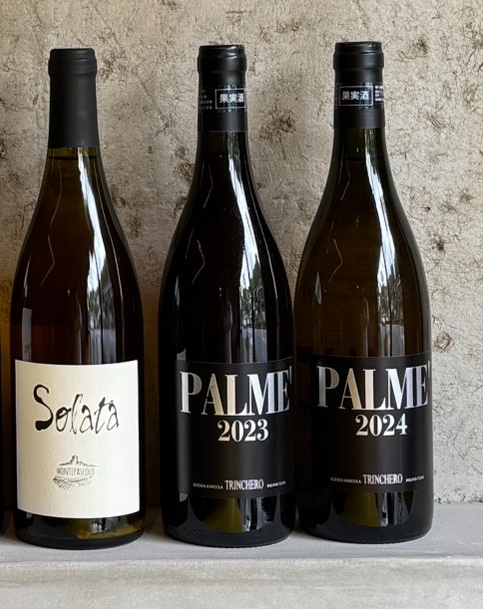
Three new wines have just arrived at Bello Vero, our Italian restaurant in Kitashirakawa, Kyoto. All three come from Italy, and they share one keyword: maceration — the practice of fermenting grape juice together with its skins, which lies at the heart of natural winemaking in northern Italy.
From a single vineyard in Piedmont called Palme, a red (Barbera) and a skin-contact white (Chardonnay); and from a small hillside in Emilia, an orange wine. Let us introduce them in order.
1. Montepascolo "Solata" (Emilia-Romagna, Italy)
The first bottle comes from the western edge of Emilia-Romagna, the Val d'Arda valley near Castell'Arquato in the province of Piacenza. Montepascolo is a tiny family estate of just 13 hectares (5 ha under vine), run by Andrea and Paola, who farm organically and are currently converting to biodynamics.
The blend is Malvasia di Candia Aromatica + Sauvignon Blanc + Moscato (some vintages also include Traminer) — three or four aromatic varieties co-fermented on their skins, in the classic northern-Italian orange-wine tradition.
The wine sees a long 50–60 day skin maceration, fermented with native yeasts in concrete tanks, then aged a further 12 months in concrete and another 12 months in bottle. Sulphites are kept to a strict minimum. Unfiltered, unfined. Around 14% alcohol.
"Solata" means "the sunny place" in Italian — the name of the vineyard itself, a wine named directly after its land.
In the glass, a luminous amber. The nose offers candied apricot, orange peel, dried herbs, black tea, beeswax, and a touch of ginger spice. On the palate, the layered aromas of three or four grapes are framed by a tannic structure from the long maceration. Soft acidity and minerality tighten the finish — complex but charming.
It pairs beautifully with Iberian ham and aged cheese, sautéed salsiccia, porcini pasta, roast chicken or pork with herbs, or spicy ethnic dishes. It embraces aromatic foods that an ordinary white cannot quite handle. Serve a touch warmer (12–14°C) and let the layers unfold in the glass.
2. Ezio Trinchero "Palme 2023" (Piedmont, Italy)
From Emilia we move northwest to Piedmont, to Agliano Terme in the province of Asti — one of the heartlands of Barbera d'Asti. Ezio Trinchero is a long-established family producer of Barbera, known as one of the early adopters of natural winemaking in this area.
"Palme" is the name of one of his vineyards: about 2 ha of Barbera planted in 1982, southeast-facing, around 250 m elevation, on calcareous soils. Both the red (Barbera) and the white (Chardonnay) are born from this same vineyard.
The grape is 100% Barbera. Fermented and macerated on the skins with native yeasts, organically farmed, made naturally. Barbera is a variety of high acidity and gentle tannin, and Asti's Barbera in particular shines for its bright, immediate fruit.
In the glass, a deep ruby. Aromas of black cherry, plum, violet, subtle spice and liquorice. On the palate, the juicy, vivid acidity typical of Barbera, fine-grained tannins, fresh fruit. Neither too heavy nor too light — a red built for the centre of the table.
Excellent with beef-shin Bolognese, salsiccia braised in tomato, mushroom and black-pepper pasta, roast veal or chicken with balsamic, or parmigiano risotto. The wines and the foods of Piedmont were made for each other. Serve slightly cool (15–16°C) to let the fruit shine.
3. Ezio Trinchero "Palme 2024" (Piedmont, Italy)
The third bottle is the white sibling born from the same Palme vineyard. The two Palme wines are not different cuvées with a shared label — they are red and white twins from a single piece of land.
The grape is 100% Chardonnay, planted in 1980, the same southeast-facing slope at 250 m on calcareous soil — right next to the Barbera. Chardonnay does appear in pockets of Piedmont (around Gattinara, for instance), but rarely treated as a "voice of the land" in this natural-wine register.
Hand-harvested in the first week of September, gently pressed, then macerated on the skins for 2–3 days before fermentation. This is the key: rather than a conventional white, this is a skin-contact white, leaning toward orange-wine territory. Aged 6 months in Slavonian oak. 13.5% alcohol.
In the glass, pale gold with a hint of amber. Unlike a typical Chardonnay it does not lead with butter or vanilla; instead, the skin-contact gives herbs, spices and dried flowers first, with yellow apple, pear and pear compote behind. On the palate, the broad fruit of Chardonnay sits alongside a gentle skin-derived grip. Oak influence is restrained; acidity and minerality keep the finish taut.
Pairs with grilled white fish with herb sauce, roast chicken with mushrooms, truffle risotto, caprese with semi-dried tomatoes, or veal with lemon and capers. It fits perfectly the dishes where a simple Chardonnay falls short and an orange wine would be too much.
All three wines are served by the bottle.
Apart from a glass of champagne (¥2,000), wines are bottle-only at Bello Vero.
Stock changes daily — please ask at the counter.
Tasting a Red and a White from the Same Vineyard
The most interesting thing about tonight's lineup is that you can taste Trinchero's Palme red and white side by side — same land, same producer, same philosophy, different grape. Barbera's juicy acidity against Chardonnay's weight and frame; each variety drawn into focus by the other.
Add Emilia's Solata orange, and the breadth of "skin-contact" expression in northern Italy opens out further. All three see maceration, yet each tastes entirely different — that contrast is the theme of the evening.
Three Roles at the Table
- Montepascolo "Solata" — orange-wine complexity, ready for aromatic dishes (antipasto to mid-meal)
- Trinchero "Palme 2023" red — Barbera's juicy acidity for the meat course
- Trinchero "Palme 2024" white — Chardonnay's depth with skin-contact aromatics, for fish or risotto
Pick the bottle that fits your dishes and the mood of the evening. We are happy to suggest at the counter.
How We Choose Wine at Bello Vero
Our wine list is organised by colour — red, white, orange, sparkling — across bottles from Japan and several European countries. We balance natural, organic and conventional wines: natural is not a moral position, and a classic bottle may simply be the best match for tonight's plate. Tell us what you are eating and how you are feeling, and we will find the right bottle.
📍 64-17 Kubota-cho, Kitashirakawa, Sakyo-ku, Kyoto
🕐 13:00–22:00 (L.O. 21:30) / Irregular closing days
2 min from Kitashirakawa bus stop / 15 min walk from Ginkakuji
📅 Reservations: Book online / TableCheck or call +81 75 600 0740